 Global Gold DAO
Gold has traditionally been traded and held through physical bars, coins, financial products, and other established market structures. Blockchain technology is now creating another possibility: representing gold-related value through digital tokens.
This concept is known as tokenized gold.
Tokenized gold combines the characteristics of gold-related assets with blockchain infrastructure, potentially making them easier to transfer, divide, and integrate with digital applications.
But how does tokenized gold actually work? What does a gold token represent, and how is it different from simply owning physical gold?
What Is Tokenized Gold?
Tokenized gold is a blockchain-based digital representation of gold or gold-related value.
The exact meaning of a gold token depends on the project issuing it.
In some structures, a token may represent a defined quantity of physical gold held by a custodian. In others, it may represent exposure to a gold-backed financial asset or another gold-related structure.
For this reason, the most important question is not simply:
“Is this a gold token?”
It is:
“What exactly does the token represent, and what assets or rights support it?”
Understanding the underlying structure is essential when evaluating any tokenized gold model.
How Does Tokenized Gold Work?
A simplified tokenization model can be divided into several layers.
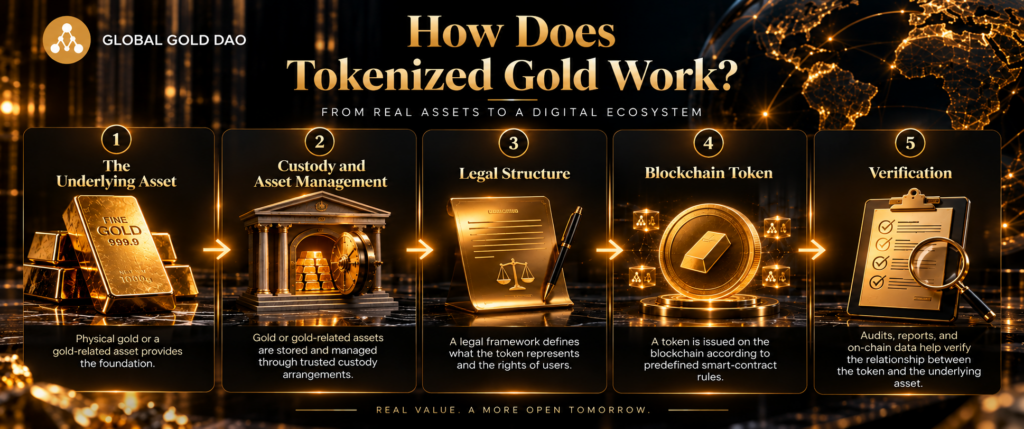
1. The Underlying Asset
The first layer is the asset itself.
For a gold-related token, the underlying structure may involve physical gold, a gold-backed exchange-traded product, or another asset linked to gold.
The underlying asset provides the foundation for the token’s economic structure.
2. Custody and Asset Management
If the model uses physical gold, the gold needs to be stored and managed through appropriate custody arrangements.
If the underlying asset is a financial product, the structure instead needs to define how that asset is held and managed.
This layer is critical because the blockchain token alone does not establish ownership of an off-chain asset.
3. Legal Structure
A tokenized gold project also needs a legal framework that defines what the token represents and what rights users have.
Depending on the project, this may include:
- ownership rights;
- redemption rights;
- transfer rights;
- eligibility requirements;
- custody arrangements;
- issuer responsibilities.
The legal structure can vary significantly between tokenized gold projects.
4. Blockchain Token
The next layer is the blockchain representation.
The project issues a token according to predefined smart-contract rules.
The token can then be transferred between compatible blockchain addresses and potentially integrated with other applications.
5. Verification
The final piece is verification.
A credible tokenized gold system needs mechanisms that allow users and other stakeholders to understand the relationship between the digital supply and the underlying asset.
Depending on the project, this can involve asset reports, attestations, audits, on-chain data, custodial records, or other forms of disclosure.
What Are the Benefits of Tokenized Gold?
Tokenization does not automatically make gold more valuable. Its primary innovation is the infrastructure used to represent and interact with gold-related value.
Greater Divisibility
Physical gold bars can be difficult to divide into small units.
A digital token can represent a defined fraction of an underlying asset.
For example, Gold on Chain defines 1 GGT as corresponding to 0.001 troy ounces of gold, creating a standardized digital unit for its gold-value layer.
On-Chain Transfer
Tokenized gold can potentially be transferred between blockchain addresses.
This allows the digital representation of gold-related value to operate within blockchain infrastructure rather than relying exclusively on traditional settlement systems.
Programmability
Blockchain tokens can interact with smart contracts.
This means tokenized gold can potentially become part of broader digital ecosystems rather than existing only as a passive representation of an asset.
Transparency
Blockchain networks provide publicly verifiable transaction records.
This can make the movement and supply of digital tokens easier to track.
However, there is an important distinction:
On-chain transparency does not automatically prove that an off-chain asset exists.
Verification of the underlying asset requires additional mechanisms.
Digital Accessibility
Tokenized gold can provide a digital interface for interacting with gold-related assets.
Instead of dealing exclusively with physical bars, users can interact with blockchain-based representations through compatible wallets and applications.
Tokenized Gold vs. Physical Gold
Tokenized gold and physical gold are fundamentally different forms of asset representation.
Physical gold is a tangible commodity.
Tokenized gold is a digital representation connected to an underlying asset or defined gold-related value.
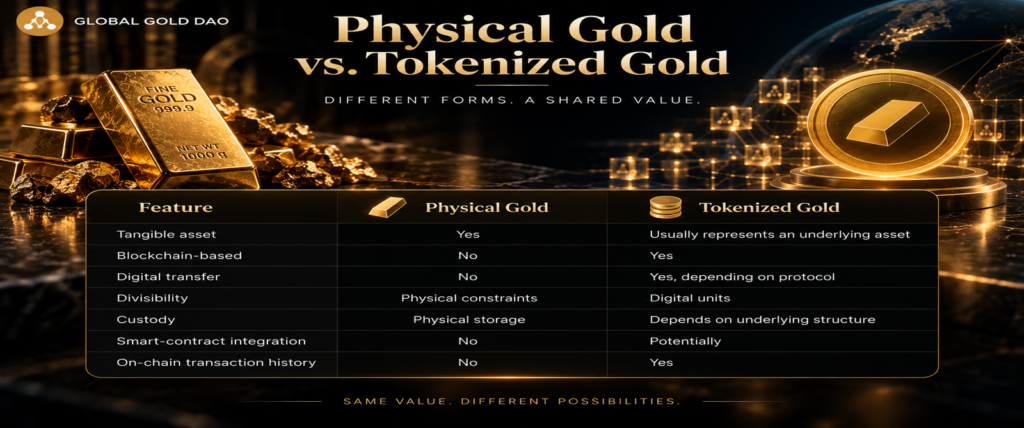
Neither model should automatically be considered superior.
They serve different purposes and operate through different infrastructures.
Is Tokenized Gold the Same as Digital Gold?
The terms “digital gold” and “tokenized gold” are sometimes used interchangeably, but they can describe different concepts.
Digital gold is a broad term that can refer to different forms of digital exposure to gold.
Tokenized gold is more specific: it generally refers to a blockchain-based token representing gold or gold-related value.
This distinction matters because not every digital gold product uses blockchain technology.
Tokenized Gold and Real-World Assets
Tokenized gold is one example of the broader Real-World Asset (RWA) movement.
RWA technology aims to connect assets that exist outside blockchain networks with digital infrastructure.
Gold is particularly relevant to this movement because it already has a long-established global market.
The tokenization process creates a bridge:
Traditional asset → Legal and custody structure → Digital token → Blockchain ecosystem
This bridge is one of the reasons tokenized gold has become an important topic in the RWA sector.
How Gold on Chain Approaches Tokenized Gold
Gold on Chain is developing an on-chain gold ecosystem through the Global Gold DAO.
Its current structure uses three main components:
- GGT — the gold-value layer;
- GGU — a synthetic gold-value unit designed to provide volatility-management mechanisms;
- GGD — the governance and ecosystem incentive layer.
According to the project’s current documentation, GGT corresponds to 0.001 troy ounces of gold, with the current underlying asset identified as the CSOP Gold ETF (3030.HK). The project’s documentation also describes direct physical gold as a planned future underlying asset.
This structure illustrates how tokenized gold can involve more than simply creating a token. It can include asset backing, issuance structures, conversion mechanisms, governance, and blockchain infrastructure.
What Should Users Look for in a Tokenized Gold Project?
Before evaluating any tokenized gold project, several questions are worth asking.
What is the underlying asset?
Understand exactly what supports the token.
Who holds or manages the underlying asset?
Custody and asset management are fundamental parts of the structure.
What does the token legally represent?
A token name alone does not define its legal rights.
How is the underlying asset verified?
Look for clear disclosures, reports, attestations, or other verification mechanisms.
How does redemption work?
Understand whether and how the token can be converted into another asset or form of value.
What blockchain does it use?
The blockchain determines how the token operates within the broader digital ecosystem.
What are the smart-contract rules?
Smart contracts define how tokens are issued, transferred, converted, or otherwise used.
The Future of Tokenized Gold
Tokenized gold sits at the intersection of traditional commodities and blockchain technology.
As RWA infrastructure develops, gold may become increasingly connected to digital ecosystems through tokenization, on-chain settlement, and programmable asset infrastructure.
However, the long-term development of tokenized gold will depend on more than blockchain adoption.
Asset verification, custody, legal frameworks, compliance, liquidity, security, and user understanding will all remain important.
The technology provides the infrastructure. The quality of the underlying asset structure determines how that infrastructure is used.
Conclusion
Tokenized gold represents a new way of connecting gold-related value with blockchain technology.
By transforming defined gold-related assets or rights into blockchain-based tokens, tokenization can enable new forms of divisibility, transfer, transparency, and programmability.
For users and institutions exploring the RWA sector, understanding the underlying asset and legal structure is just as important as understanding the blockchain technology itself.
As projects such as Gold on Chain develop their on-chain gold ecosystems, tokenized gold is becoming an increasingly important area to watch in the evolution of Real-World Assets.
Copyright © 2026 Global Gold DAO ecosystem. All rights reserved.