 Global Gold DAO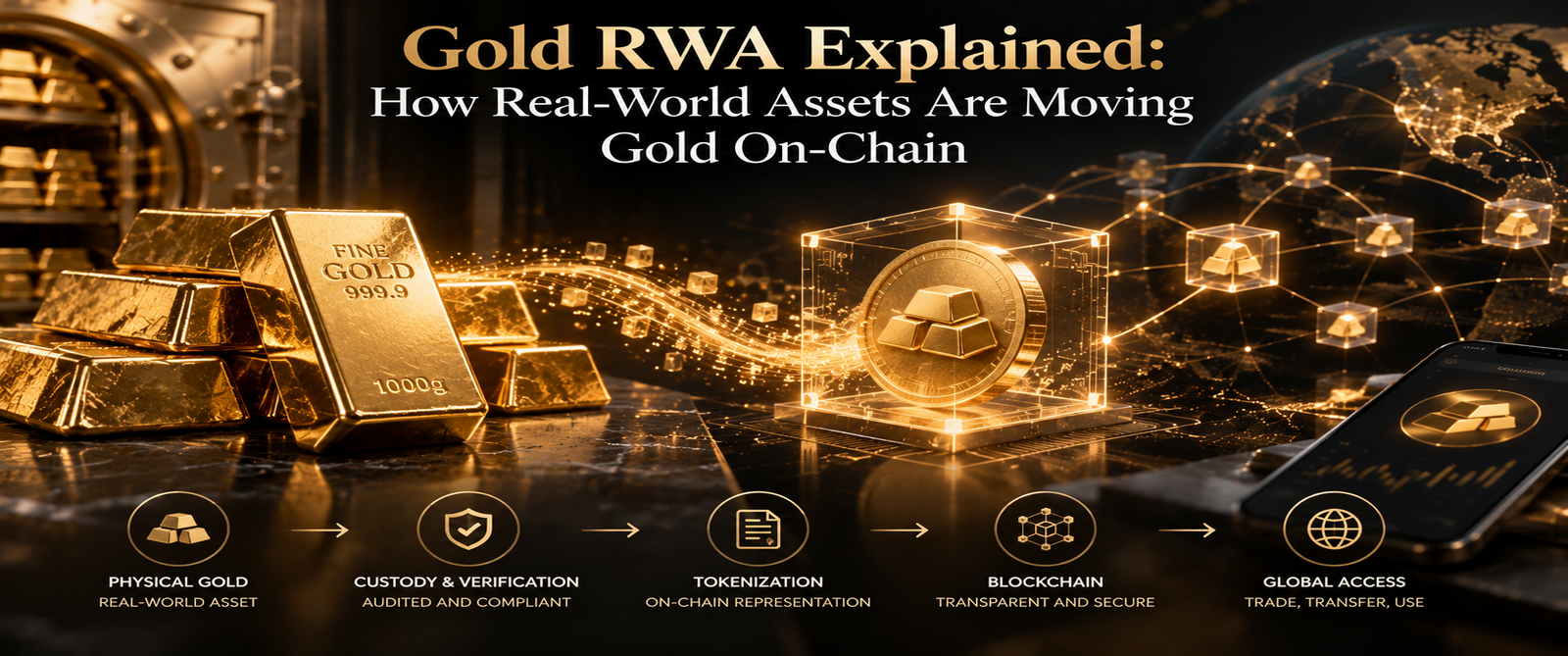
Gold has traditionally existed through physical bars, coins, ETFs and other financial products. Blockchain technology is creating another possibility: representing gold-related value through digital infrastructure.
This concept is part of the broader Real-World Asset (RWA) movement.
But what exactly is Gold RWA, how does it work, and why is gold becoming an important asset in the tokenization industry?
What Is Gold RWA?
Gold RWA refers to gold or gold-related value represented through blockchain-based infrastructure.
RWA stands for Real-World Asset, describing assets or financial interests that exist outside blockchain networks but can be represented digitally on-chain.
Gold is particularly relevant because it already has a large and established global market. The World Gold Council estimates that more than 220,000 tonnes of gold have been mined throughout history, with the above-ground stock valued at approximately $31 trillion at the end of 2025. (World Gold Council)
Tokenization creates a bridge between this traditional asset and blockchain infrastructure.
How Does Gold RWA Work?
A simplified Gold RWA structure can include several layers:
1. Underlying Asset
The first layer is the asset supporting the digital representation.
Depending on the project, this could involve:
- Physical gold
- A gold ETF
- Another financial instrument linked to gold
The exact structure is important because different tokenized gold products can represent different forms of economic exposure.
2. Legal and Custody Structure
If physical gold is involved, it needs to be properly held and managed.
The legal structure also determines what rights the token holder actually has, including ownership, redemption and transfer rights.
3. Blockchain Token
The asset or economic exposure can then be represented through a blockchain token.
This allows the digital representation to potentially be transferred and integrated with blockchain applications.
4. Verification
A Gold RWA system also needs mechanisms to establish the relationship between the digital token and its underlying asset.
These mechanisms can include attestations, reports, custody records and on-chain information.
The blockchain itself records transactions, but on-chain activity alone does not prove that an off-chain asset exists.
Why Is Gold Becoming Important in RWA?
Gold is already a globally recognized asset with established financial markets.
Tokenization can potentially add new digital capabilities, including:
Divisibility — gold-related value can be represented in smaller digital units.
On-chain transfer — tokens can potentially move between compatible blockchain addresses.
Programmability — tokens can interact with smart contracts and other blockchain applications.
Digital accessibility — users can interact with gold-related value through digital wallets and Web3 infrastructure.
The market is already expanding. CoinGecko reported that tokenized commodities reached approximately $5.55 billion in market capitalization by the end of Q1 2026, with gold-backed tokens accounting for most of the growth. Tokenized gold also generated approximately $90.7 billion in spot trading volume during Q1 2026. (CoinGecko)
Gold RWA and Web3
One of the interesting aspects of Gold RWA is that it connects traditional assets with the programmable nature of blockchain.
Instead of gold-related value existing only within traditional financial infrastructure, tokenized representations can potentially interact with:
- Blockchain wallets
- Smart contracts
- DeFi applications
- On-chain settlement
- Digital asset ecosystems
The World Gold Council has also been exploring shared infrastructure for digital gold, including custody, reconciliation, compliance and redemption. (World Gold Council)
This shows that tokenized gold is becoming a broader infrastructure discussion rather than simply a cryptocurrency trend.
How Gold on Chain Uses the Gold RWA Model
Gold on Chain is developing an on-chain gold ecosystem through Global Gold DAO.
Its current architecture uses three main components:
- GGT — gold-value layer
- GGU — synthetic gold-value and volatility-management layer
- GGD — governance and ecosystem incentives
According to the current Whitepaper, 1 GGT corresponds to 0.001 troy ounces of gold, while the current underlying asset is the CSOP Gold ETF (3030.HK). Direct physical gold is planned for a later phase. (Gold on Chain)
This distinction is important: Gold RWA does not necessarily mean that every token is directly backed by physical gold today. The underlying structure depends on the specific project.
The Future of Gold RWA
The tokenization of gold sits at the intersection of traditional finance, commodities and Web3.
As blockchain infrastructure develops, gold-related assets may become increasingly connected to digital settlement, smart contracts and on-chain financial applications.
However, the underlying asset, custody, legal rights, compliance and verification mechanisms remain just as important as the blockchain technology itself.
Gold RWA is ultimately about creating a bridge between established gold markets and a new generation of digital financial infrastructure.
FAQ
What does Gold RWA mean?
Gold RWA refers to gold or gold-related value represented through blockchain-based infrastructure.
Is Gold RWA the same as physical gold?
Not necessarily. Different projects can use physical gold, ETFs or other gold-related structures.
Why is gold being tokenized?
Tokenization can introduce digital transferability, divisibility, programmability and integration with blockchain applications.
What is GGT?
GGT is the gold-value layer of the Gold on Chain ecosystem. The current protocol reference is 1 GGT = 0.001 troy ounces of gold. (Gold on Chain)