 Global Gold DAO
Tokenized gold is bringing one of the world’s oldest financial assets into a new technological environment.
Blockchain can make gold-related value easier to transfer and integrate with digital applications, but tokenization also raises important questions about custody, ownership, compliance, investor protection and market structure.
As the sector develops, regulation is becoming an increasingly important part of the conversation.
Why Does Tokenized Gold Need Regulation?
A blockchain token does not automatically define what an investor owns.
A tokenized gold product can have different underlying assets, legal structures and redemption mechanisms depending on the project.
For example, a token could represent:
- Physical gold held by a custodian
- A gold-backed ETF
- Another financial instrument linked to gold
- A defined economic interest in a gold-related structure
Because these models are different, regulators need to consider what rights and protections apply to each structure.
The UK Is Examining Tokenized Gold
The regulatory discussion is already moving forward.
On September 14, 2026, the UK’s Financial Conduct Authority (FCA) published a Call for Input on tokenised gold in UK wholesale markets. The FCA is seeking views on whether tokenization could improve how gold is traded, transferred, pledged and held.
The FCA is also examining potential challenges around the regulatory perimeter, including questions involving collective investment schemes and alternative investment funds.
The consultation is open until October 23, 2026.
This is significant because London is one of the world’s major centers for the gold market, and the FCA specifically identifies wholesale-market applications and collateral use as areas of interest.
What Areas Matter Most?
Regulation of tokenized gold involves several important areas.
Custody
If physical gold supports a digital token, the market needs clear arrangements for how that gold is stored and managed.
Ownership and Legal Rights
Users need to understand what their tokens legally represent.
Redemption
A tokenized gold system should clearly define whether and how users can redeem their position.
Compliance
KYC, AML and jurisdictional requirements can be important depending on the structure and market in which the product operates.
Transparency
Information about underlying assets, issuance and relevant reports can help users understand the relationship between tokens and their underlying structure.
How Gold on Chain Addresses Compliance
Compliance and transparency are incorporated into the Gold on Chain protocol architecture.
The project’s documentation includes dedicated sections covering KYC/AML, reports and transparency, smart-contract security audits, price oracles and exception handling.
The protocol also describes restricted-jurisdiction controls and blockchain-based screening mechanisms as part of its compliance framework.
For GGT, the current underlying asset is the CSOP Gold ETF (3030.HK), while the project describes a planned evolution toward an ETF-plus-physical-gold structure.
Why Regulation Could Shape Gold RWA
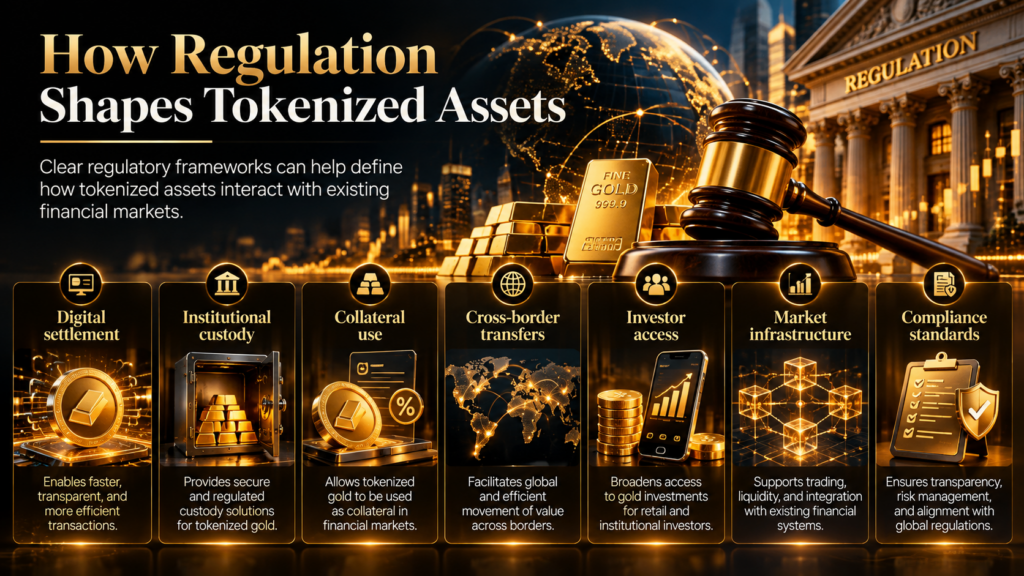
The FCA has already indicated that it is exploring whether tokenized gold could support new forms of wholesale-market infrastructure while maintaining market integrity and consumer protection.
Conclusion
The future of tokenized gold will depend on more than blockchain technology.
Custody, legal rights, transparency, compliance and market infrastructure will all play important roles.
As regulators increasingly examine gold tokenization, projects operating in the Gold RWA sector will need to demonstrate not only technological functionality but also clear structures around the assets and rights represented by their tokens.
For the Gold on Chain ecosystem, compliance and transparency are already included as core components of the protocol’s documented architecture.
FAQ
Why is tokenized gold being regulated?
Because tokenized gold can involve financial assets, physical commodities, custody arrangements and investor rights.
What is the FCA doing about tokenized gold?
The FCA published a Call for Input in September 2026 to examine opportunities and risks associated with tokenised gold in UK wholesale markets.
Does blockchain automatically prove that gold exists?
No. Blockchain can provide transparent transaction records, but underlying-asset verification requires additional mechanisms.
Does Gold on Chain have compliance mechanisms?
The protocol documentation includes KYC/AML, jurisdictional controls, transparency mechanisms and smart-contract security measures.