 Global Gold DAO
Collateral is one of the foundations of lending.
Traditionally, assets such as real estate, securities and physical commodities can be used to secure loans. As financial assets move onto blockchain networks, tokenized gold is becoming another potential form of digital collateral.
This creates a connection between gold and digital lending markets.
What Does It Mean to Use Gold as Collateral?
Collateral is an asset pledged to support a loan.
In a simplified example, a borrower deposits an asset worth $100,000 and receives a smaller amount of financing against it.
If the borrower does not meet the required conditions or the collateral value falls significantly, the lender may have the right to liquidate the collateral according to the applicable rules.
With tokenized gold, the same basic concept can operate through blockchain infrastructure.
Instead of depositing physical gold, the user deposits a digital token representing gold or gold-related value.
How Does Tokenized Gold Collateral Work?
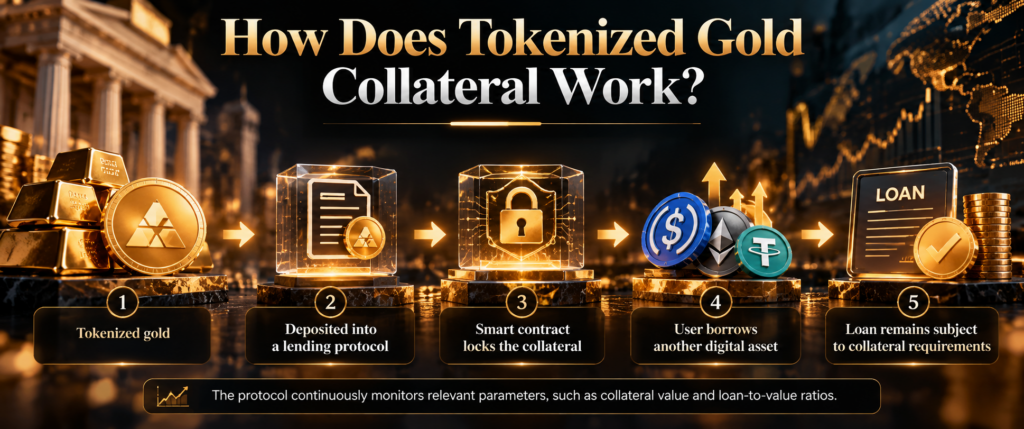
If the collateral falls below the required threshold, liquidation mechanisms may be triggered.
Is This Already Happening?
Yes.
Tokenized gold is already being integrated into decentralized lending infrastructure.
Aave’s current Ethereum Core market lists Tether Gold (XAUt) as supported collateral and shows a 75% collateral factor. The platform also lists several assets that can be borrowed against XAUt. (aave.com)
Aave governance has also approved the onboarding of PAXG into its V4 Ethereum Global Dollar Hub. The proposal described PAXG as a gold-backed RWA that can expand collateral and liquidity options within the ecosystem. (governance.aave.com)
In September 2026, Arch Lending also announced that it had begun accepting PAXG and XAUT as collateral for crypto-backed loans, with starting loan-to-value ratios of up to 75%. (chainwire.org)
These examples show that gold-backed digital lending is becoming an active use case rather than simply a theoretical application.
Why Is Gold Interesting as Collateral?
Established Asset Class
Gold has a long-established global market and widely followed pricing benchmarks.
Digital Transferability
Tokenized gold can be transferred through blockchain infrastructure, subject to the rules of the token and protocol.
Portfolio Diversification
Gold-backed collateral can provide an alternative to using only crypto-native assets.
Programmability
Smart contracts can automate collateral management and liquidation according to predefined parameters.
Capital Efficiency
In certain structures, users can obtain liquidity without directly selling their gold-related position.
What Are the Risks?
Using tokenized gold as collateral does not eliminate financial risk.
Price Risk
Gold prices can decline, reducing the value of collateral.
Liquidation Risk
If collateral falls below a protocol’s required threshold, positions can potentially be liquidated.
Liquidity Risk
A token may have insufficient market liquidity to absorb large liquidations efficiently.
Oracle Risk
Lending protocols depend on accurate price data to calculate collateral values.
Smart-Contract Risk
A vulnerability in a DeFi protocol can affect lending and collateral mechanisms.
Underlying-Asset Risk
The structure supporting the token also matters. Users need to understand custody, legal rights and the underlying asset.
What About GGT?
Gold on Chain’s ecosystem is designed with GGT as its gold-value layer.
The project’s Media materials describe GGT as supporting on-chain applications including lending, liquidity mining and yield aggregation. (goldonchain.io)
The current GGT underlying asset is the CSOP Gold ETF (3030.HK), with 1 GGT corresponding to 0.001 troy ounces of gold under the protocol’s reference structure. (goldonchain.io)
The protocol also includes GGU as a synthetic gold-value unit designed to reduce the impact of gold-price volatility within the ecosystem. The Whitepaper describes GGU as a USD-referenced synthetic unit rather than a conventional 1:1 fiat-reserve stablecoin. (goldonchain.io)
This multi-token architecture creates different roles for gold value, volatility management and governance.
Why Could Gold Collateral Matter for RWA?
One of the central ideas behind RWA tokenization is making traditional assets more compatible with digital financial infrastructure.
Gold-backed collateral is a clear example.
Instead of gold existing separately from blockchain-based credit markets, a tokenized representation can potentially become part of lending protocols and other financial applications.
This creates a pathway:
Traditional gold → Tokenization → Digital collateral → On-chain lending
The result is not simply a digital version of gold. It is a potential new use case for gold within programmable financial infrastructure.
The Future of Gold-Backed Lending
As tokenized assets become more integrated with DeFi and institutional finance, gold could potentially play a larger role in digital collateral markets.
However, growth will depend on more than demand.
Lending protocols need:
- Reliable price oracles
- Sufficient liquidity
- Clear collateral parameters
- Strong smart-contract security
- Defined liquidation mechanisms
- Reliable underlying-asset structures
- Appropriate compliance frameworks
These components determine how tokenized gold can be integrated responsibly into digital credit markets.
Conclusion
Tokenized gold is increasingly being used as collateral in blockchain-based lending systems.
The development of XAUt and PAXG within lending protocols demonstrates that gold-backed digital assets can serve functions beyond simply tracking gold prices. (aave.com)
For the broader Gold RWA sector, collateral represents an important step toward making tokenized assets more useful and composable within digital financial infrastructure.
Gold on Chain’s GGT architecture is designed with this broader on-chain utility in mind, connecting gold-related value with blockchain-based applications and ecosystem infrastructure.
FAQ
Can tokenized gold be used as collateral?
Yes. DeFi platforms including Aave currently support certain tokenized-gold assets as collateral. (aave.com)
What happens if the value of the gold falls?
If collateral falls below a protocol’s required threshold, liquidation may occur according to the protocol’s rules.
What is loan-to-value (LTV)?
LTV measures the amount borrowed relative to the value of the collateral.
Can GGT be used in lending applications?
Gold on Chain’s documentation describes GGT as supporting on-chain lending and other DeFi-related applications. (goldonchain.io)
What is the current underlying asset for GGT?
The current underlying asset identified by Gold on Chain is the CSOP Gold ETF (3030.HK). (goldonchain.io)