 Global Gold DAO
Cross-border payments remain one of the areas where financial infrastructure can be slow and operationally complex. Transactions between countries often involve multiple institutions, currencies, settlement systems and compliance requirements.
At the same time, blockchain technology has introduced a different way of moving digital value across networks.
This raises an interesting question: could tokenized gold become part of the infrastructure used for cross-border payments and international value transfers?
The answer is potentially yes, although tokenized gold is not simply a replacement for traditional payment systems.
Instead, it can function as a digital representation of gold-linked value that can move on-chain, potentially connecting gold markets with blockchain-based financial infrastructure.
What Are Tokenized Gold Cross-Border Payments?
Tokenized gold cross-border payments refer to international transfers in which a blockchain-based gold-linked asset is used somewhere in the transaction or settlement process.
A simplified structure could look like this:
Gold-linked asset → Tokenization → Blockchain transfer → Conversion or settlement → Local currency or digital asset
Rather than physically moving gold between countries, the transaction moves a digital representation of gold-linked value.
This can make the movement of value considerably more compatible with digital financial infrastructure.
The World Gold Council has identified portability, cross-border transfers and settlement as important potential applications of digital gold infrastructure. Its 2026 research describes a future in which gold could be transferred across digital rails while maintaining clear legal ownership, custody and assurance mechanisms. World Gold Council
Why Would Gold Be Useful in Cross-Border Transfers?
Gold already has a global market and internationally recognized pricing infrastructure.
Physical gold, however, is difficult to move directly.
Transporting physical gold can involve vaults and custodians, insurance, transportation, geographic restrictions, settlement procedures, ownership documentation, different legal jurisdictions.
A tokenized representation changes the operational layer.
Instead of transporting a gold bar from one country to another, the blockchain transaction can transfer the relevant digital asset while the underlying asset remains within its custody structure.
This is one of the fundamental ideas behind digital gold infrastructure.
Blockchain Can Make Gold More Transferable
One of the main characteristics of blockchain-based assets is that ownership records can be transferred digitally.
For a properly structured tokenized gold product, the blockchain can record, the creation of the token, the transfer between wallets, the corresponding token balance, transaction history, smart-contract rules, potential redemption or conversion processes.
This does not eliminate the need for traditional financial infrastructure.
Instead, blockchain becomes an additional settlement and transfer layer.
The World Gold Council’s Gold247 initiative similarly explores how digital infrastructure could make gold interests easier to transfer while connecting digital records with physical custody, reconciliation and legal frameworks. World Gold Council
Tokenized Gold Does Not Mean Borderless Regulation
One important distinction is that blockchain transfers can be global even when financial regulations are not.
A token may technically be transferable between two blockchain addresses, but the people or institutions involved can still be subject to, KYC requirements, AML rules, sanctions restrictions, securities regulations, payment regulations, foreign-exchange rules, local restrictions on digital assets.
The World Gold Council specifically identifies cross-border compliance as one of the major challenges facing tokenized gold. Global transferability can conflict with jurisdiction-specific regulations. World Gold Council
Therefore, the future of tokenized gold payments is likely to depend on the interaction between blockchain infrastructure and regulated financial systems, rather than blockchain operating independently of them.
Real-World Experiments Are Already Emerging
The concept is moving beyond theory.
In 2026, Singapore-based MetaComp announced a proof-of-concept using Tether Gold (XAUT) for a cross-border transfer between USD and EUR. According to the company, the transaction converted USD into XAUT in Singapore and subsequently converted the XAUT into EUR, with the proceeds delivered to a European bank account. MCE
The example is important because the tokenized gold did not need to replace the banking system.
Instead, it functioned as an intermediate digital settlement asset between different currencies.
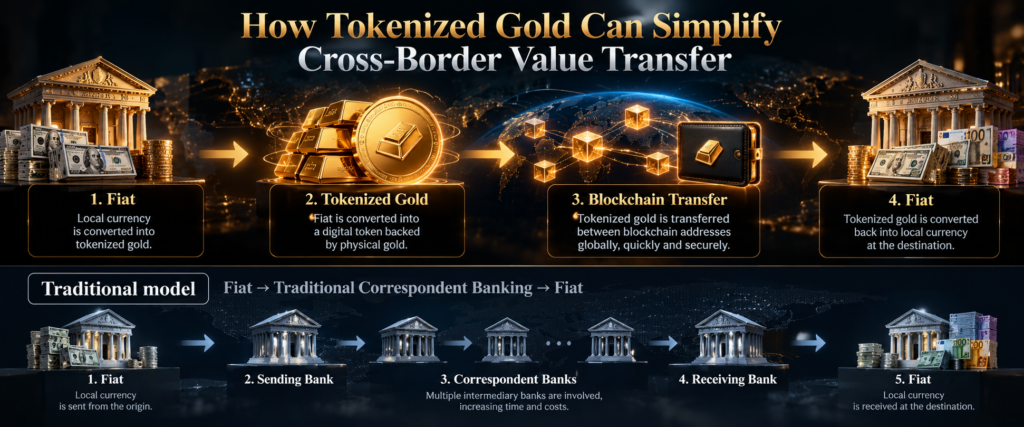
The first structure could potentially reduce certain settlement frictions, although its effectiveness depends on liquidity, regulation, infrastructure and the specific payment corridor.
How Gold on Chain Fits Into This Model
Gold on Chain is designed around a similar idea of connecting gold-linked value with blockchain infrastructure.
Its current gold-value token, GGT, represents the value equivalent of 0.001 troy ounces of gold. The current underlying asset is CSOP Gold ETF (3030.HK), while the project plans to expand its underlying structure to include directly held physical gold in a future phase. goldonchain.io
The Whitepaper also specifies that GGT supports permissionless on-chain transfers, while the protocol is initially deployed on BNB Chain. goldonchain.io
This creates an infrastructure in which gold-linked value can potentially move between blockchain addresses without requiring the underlying asset itself to physically move.
The ecosystem also includes GGU, a synthetic USD-denominated value unit designed as a volatility-buffering layer, and GGD, which provides governance and ecosystem functions.
From Gold Ownership to Digital Value Transfer
The larger opportunity is not necessarily to make gold itself a conventional payment currency.
Instead, tokenization can make gold more compatible with digital financial infrastructure.
A tokenized gold asset could potentially be:
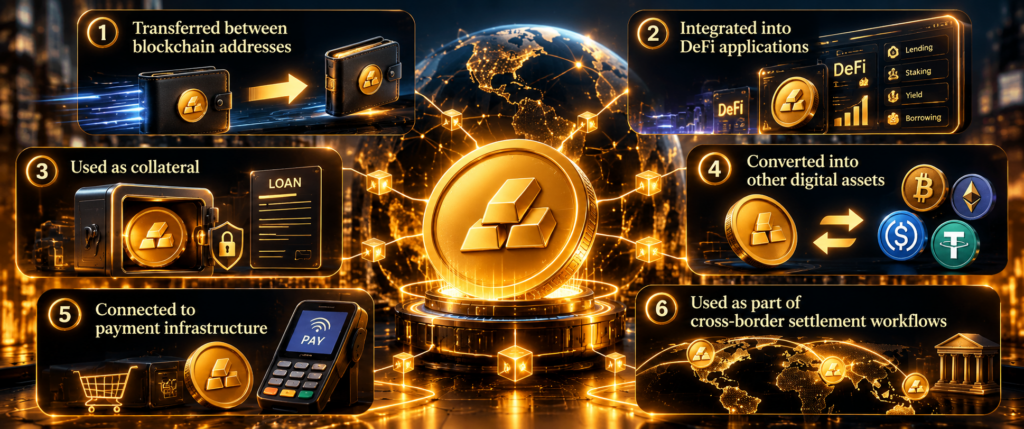
The World Gold Council’s 2026 research describes a mature digital-gold market in which gold could be held, transferred, pledged and redeemed through trusted digital rails. World Gold Council
The Future of Cross-Border Gold Transfers
Tokenized gold is unlikely to eliminate banks, payment providers or local currencies.
Its more realistic role may be as a new settlement layer connecting traditional assets with digital financial networks.
As tokenization infrastructure develops, gold could become easier to move digitally while maintaining connections to custody, legal ownership, redemption and traditional markets.
The key challenge will be creating systems where speed and programmability do not come at the expense of custody, compliance and trust.
FAQ
Can tokenized gold be used for international payments?
Potentially. Tokenized gold can function as a digital settlement or transfer asset, although actual payment use depends on the specific token, infrastructure, liquidity and regulatory environment.
Does cross-border transfer require moving physical gold?
Not necessarily. A tokenized structure can transfer the digital representation while the underlying gold or gold-linked asset remains in its custody structure.
Is tokenized gold the same as a stablecoin?
No. Tokenized gold generally derives its value from gold or gold-linked assets. Its price can therefore move with gold unless the structure includes a separate hedging mechanism.
Can GGT be transferred internationally?
The Gold on Chain Whitepaper specifies permissionless on-chain GGT transfers, subject to the protocol’s rules and applicable compliance requirements. goldonchain.io
Conclusion
Cross-border payments are increasingly becoming a technology problem as much as a banking problem.
Tokenized gold offers one possible bridge between traditional stores of value and blockchain-based settlement infrastructure. By representing gold-linked value digitally, blockchain can make transfers more programmable, divisible and compatible with digital financial applications.
The next stage of digital gold may therefore be less about simply putting gold on a blockchain and more about making gold usable within a connected global financial infrastructure.