 Global Gold DAO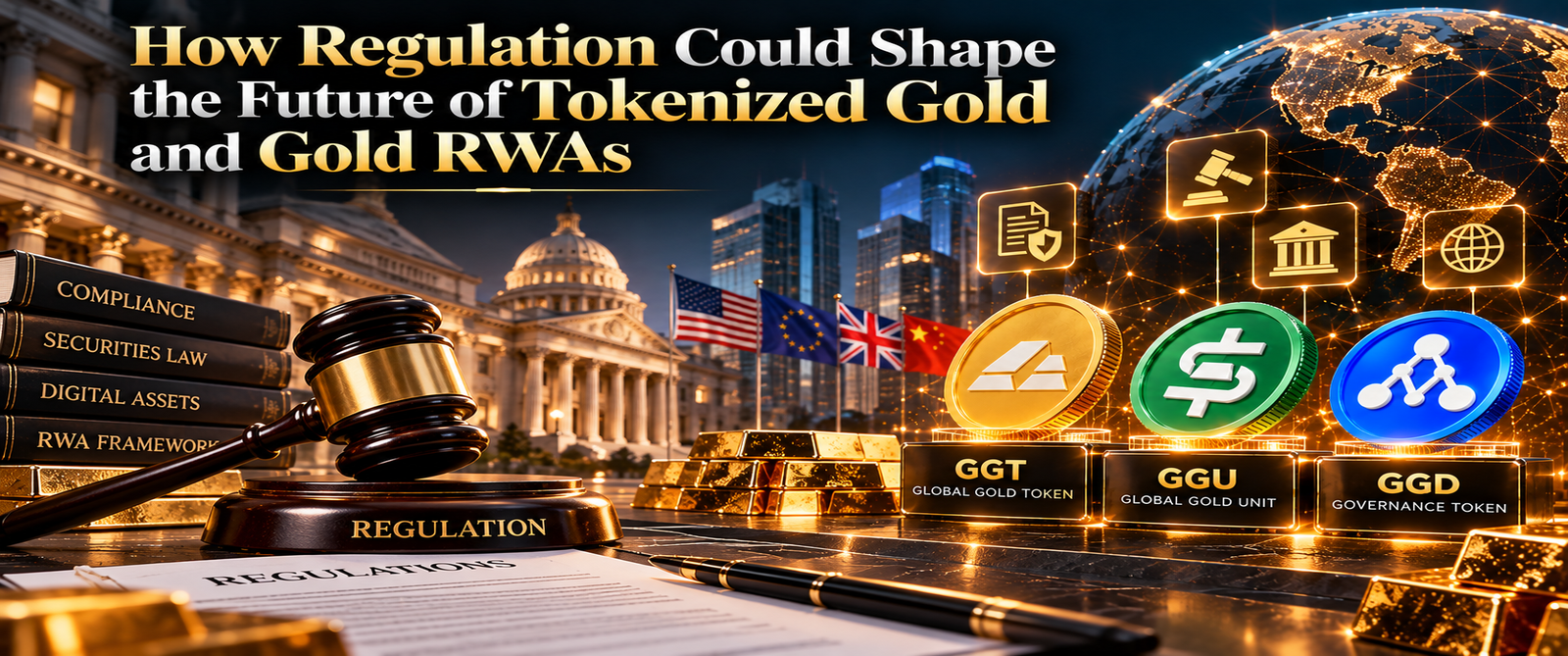
Tokenized gold is connecting traditional gold markets with blockchain infrastructure.
But technology alone cannot determine how this market develops.
As tokenized gold becomes more relevant to financial institutions and investors, regulation, custody, legal rights and compliance are becoming equally important.
Why Does Regulation Matter?
A blockchain token does not automatically explain what the holder owns.
Different tokenized-gold models can represent different things.
For example, a token may be connected to:
- Physical gold
- A gold ETF
- Another gold-related financial product
- A defined economic interest
Each structure can involve different legal rights, custody arrangements and redemption mechanisms.
Clear regulation can help establish how these products should operate within existing financial markets.
The FCA Is Studying Tokenized Gold
A significant development came on September 14, 2026, when the UK’s Financial Conduct Authority launched a Call for Input on tokenised gold.
The FCA is examining whether tokenization could improve how gold is:
- Traded
- Transferred
- Pledged
- Held
The regulator is particularly interested in wholesale-market use cases and the possibility of tokenized gold being used as collateral. (fca.org.uk)
The FCA also highlighted questions around the regulatory perimeter, including potential treatment under collective investment scheme and alternative investment fund frameworks. (fca.org.uk)
Regulation Could Influence Institutional Adoption
Institutional participants typically need clearly defined rules around assets and counterparties.
For tokenized gold, this can include:
Custody
Where is the underlying gold held, and who is responsible for it?
Legal Rights
What does ownership of the token actually provide?
Redemption
Can the token be redeemed, and under what conditions?
Compliance
What KYC, AML and jurisdictional requirements apply?
Transparency
How can participants verify the relationship between the token supply and the underlying asset?
These questions are particularly important when blockchain-based assets interact with traditional financial markets.
Regulation and Digital Gold Infrastructure
The regulatory discussion is happening alongside broader infrastructure development.
In March 2026, the World Gold Council and Boston Consulting Group published research proposing a shared infrastructure model for digital gold.
The concept, called “Gold as a Service,” aims to connect physical gold custody with digital systems used to issue and manage gold-backed products, while standardizing processes such as custody coordination, reconciliation, compliance and redemption. (gold.org)
This illustrates how the future of digital gold may depend on both blockchain technology and supporting financial infrastructure.
How Gold on Chain Approaches Compliance
Gold on Chain’s protocol documentation includes compliance and transparency as part of its architecture.
The Whitepaper describes mechanisms including KYT/KYA screening, AML controls, restricted-jurisdiction controls and third-party security audits. (goldonchain.io)
The project’s transparency page separately identifies the current GGT underlying asset as CSOP Gold ETF (3030.HK) and lists the current custody chain associated with that asset. It also states that underlying-asset reports, valuation reports and smart-contract audit information are to be disclosed according to the project’s stated publication status. (goldonchain.io)
What Could Regulation Change?
Regulation could influence several parts of the tokenized-gold market.
Market access: who can issue, distribute or trade certain products.
Custody: standards for safeguarding underlying assets.
Disclosure: what information issuers need to provide.
Redemption: how token holders can exercise defined rights.
Collateral: how tokenized gold can potentially be used within financial transactions.
Cross-border activity: how digital gold products interact across jurisdictions.
The exact regulatory approach will differ between jurisdictions and product structures.
Gold RWA and the Next Stage of Financial Infrastructure
Tokenized gold is part of a broader RWA movement.
CoinGecko reported that tokenized RWAs reached approximately $19.3 billion by the end of Q1 2026, while tokenized commodities reached approximately $5.5 billion, driven largely by gold-backed tokens. (coingecko.com)
As this market grows, regulation may increasingly focus on how blockchain-based assets interact with established financial infrastructure.
For Gold RWA projects, this means that technology, asset backing and compliance need to develop together.
Conclusion
The future of tokenized gold will be shaped by more than blockchain adoption.
Clear legal structures, custody, asset verification, compliance and market infrastructure will all influence how tokenized gold develops.
The FCA’s current work on tokenised gold shows that regulators are actively examining how the technology could be used within wholesale financial markets. (fca.org.uk)
At the same time, institutions and industry organizations are building infrastructure designed to connect physical gold with digital systems.
For Gold on Chain, this broader transition is reflected in an ecosystem built around GGT, GGU and GGD, with documented mechanisms for asset structure, compliance, transparency and governance. (goldonchain.io)
As Gold RWA develops, regulation may become not simply a constraint, but an important part of the infrastructure required for digital gold to operate at greater scale.
FAQ
Why is regulation important for tokenized gold?
Because tokenized gold can involve physical assets, financial products, custody, legal rights and cross-border activity.
What is the FCA doing about tokenized gold?
The FCA launched a Call for Input on September 14, 2026, examining opportunities and risks for tokenised gold in UK wholesale markets. (fca.org.uk)
Does regulation guarantee that a tokenized-gold project is safe?
No. Regulation and compliance are important components, but they do not eliminate market, technology, custody or other risks.
Does Gold on Chain have a compliance framework?
Its current Whitepaper describes KYC/KYT, AML, jurisdictional controls, transparency measures and security audits as components of the protocol architecture. (goldonchain.io)