 Global Gold DAO
Gold has been stored in vaults, transported between financial centers and traded through increasingly sophisticated markets for centuries.
Today, however, another layer is being added to the gold market: blockchain-based digital infrastructure.
Tokenization does not eliminate physical gold, vaults or custodians. Instead, it can create a digital layer that connects these traditional components with programmable financial systems.
This creates a possible transition from: Physical storage → Traditional settlement toward: Physical or gold-linked assets → Digital representation → Blockchain settlement
Why Is Gold Storage Still Important?
Gold is a physical commodity.
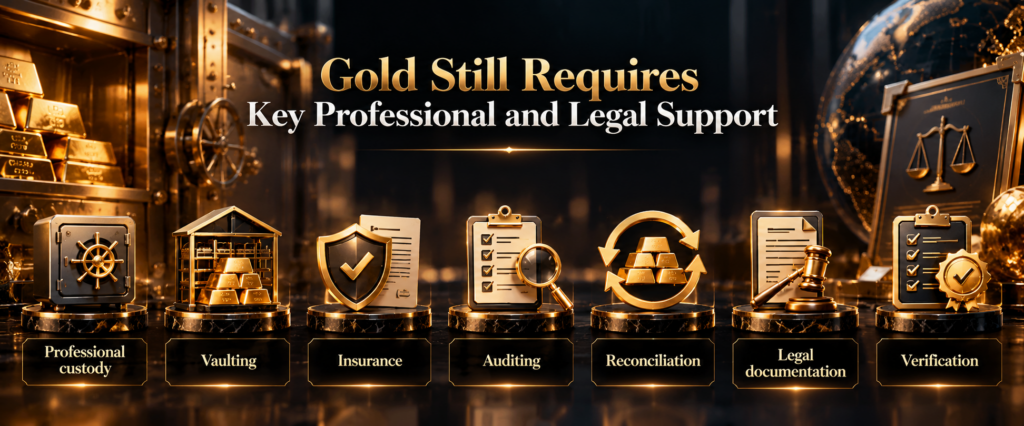
This means tokenization does not make physical infrastructure irrelevant.
In fact, the opposite can be true.
The stronger the connection between the digital token and the underlying asset, the more important custody and verification become.
The World Gold Council’s 2026 digital-gold research proposes infrastructure connecting physical custody with the digital systems used to issue and manage gold-backed products. World Gold Council
What Changes When Gold Is Tokenized?
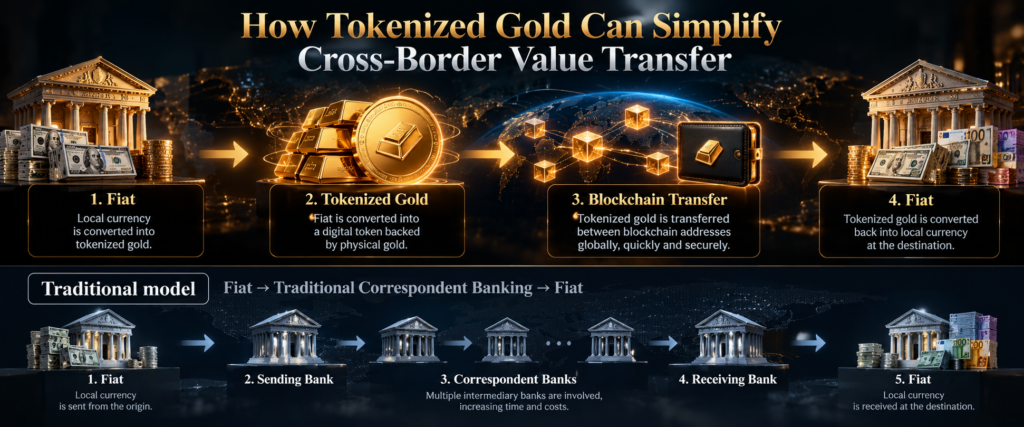
In a traditional gold market, transferring ownership can involve multiple records and intermediaries.
Tokenization introduces a blockchain-based record representing a defined economic or ownership interest.
A simplified architecture can look like this:
Underlying Gold / Gold-Linked Asset
↓
Custody & Legal Structure
↓
Token Issuance
↓
Blockchain Record
↓
Digital Transfer
↓
Settlement / Redemption
The blockchain therefore becomes a digital coordination layer.
It records token movements while the underlying asset remains subject to its own custody and legal framework.
Digital Settlement Is Different From Physical Delivery
One of the most important distinctions in digital gold is the difference between transferring a digital interest and physically delivering gold.
A blockchain transaction can happen without a gold bar being moved.
For example, if Alice transfers a token representing gold-linked value to Bob, the blockchain can record the transaction almost immediately.
The physical gold or underlying financial asset may remain exactly where it was.
Physical delivery would only become necessary if Bob later exercises a redemption right under the relevant product’s rules.
The World Gold Council defines settlement as the completion of a transaction through transfer of asset ownership and the corresponding payment or consideration, while redemption is a separate process involving conversion into physical gold or cash subject to defined conditions. World Gold Council
The Importance of Custody
This creates one of the biggest questions surrounding tokenized gold:
Who actually holds the underlying asset?
A blockchain ledger can show that a token exists and that it moved from one address to another.
But blockchain data alone cannot prove that the corresponding off-chain asset exists.
That requires additional infrastructure, such as custodian records, independent attestations, audits, reconciliation, legal documentation, reserve reporting.
This is why modern digital-gold proposals increasingly focus on connecting blockchain records with custody and verification systems.
The World Gold Council’s proposed “Gold as a Service” infrastructure specifically focuses on custody coordination, reconciliation, compliance and redemption. World Gold Council
How Blockchain Could Improve Gold Transfers
If the physical and digital layers are properly connected, blockchain could improve several parts of the gold transfer process.
1. Faster Digital Transfers
Blockchain transactions can record transfers without requiring physical movement of the underlying asset.
2. Greater Transparency
Transaction histories can be recorded on-chain and independently inspected, depending on the structure of the system.
3. Programmability
Smart contracts can establish rules for issuance, transfers, conversion, collateralization and other functions.
4. Fractional Digital Representation
A large physical asset can potentially be represented through smaller digital units.
5. Integration With Other Financial Applications
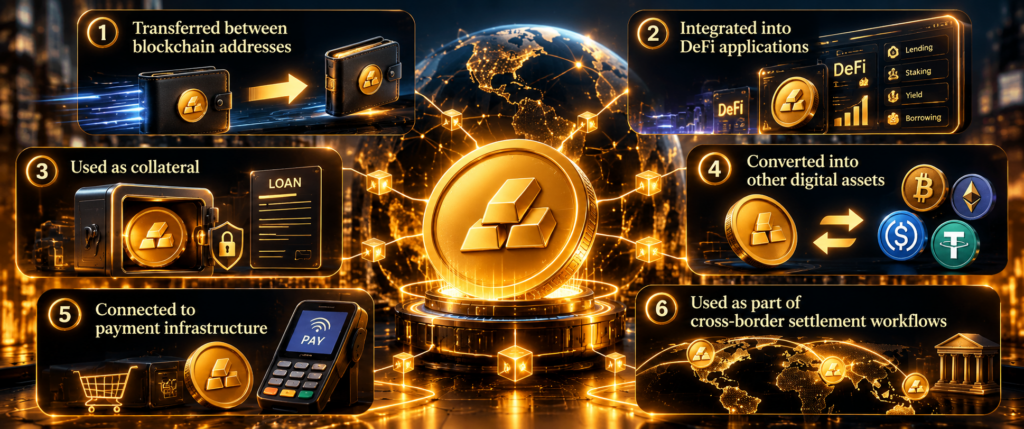
Tokenized gold can potentially interact with DeFi protocols, digital wallets and other blockchain applications.
These capabilities are part of the broader argument for bringing real-world assets onto programmable networks.
Gold on Chain’s Approach
Gold on Chain uses a three-token architecture designed to connect gold-linked value with blockchain infrastructure.
GGT is the gold-value layer. According to the current Whitepaper, 1 GGT corresponds to the value equivalent of 0.001 troy ounces of gold. Its current underlying asset is CSOP Gold ETF (3030.HK), with directly held physical gold planned as part of a future expanded asset structure. goldonchain.io
GGU serves as a synthetic USD-denominated value unit and volatility-buffering layer. It combines gold exposure with a gold-hedging position and is explicitly not a conventional 1:1 fiat-reserve stablecoin. goldonchain.io
GGD serves as the governance and ecosystem incentive token.
The Whitepaper also specifies on-chain transfer functionality for GGT and GGU and describes an initial deployment on BNB Chain. goldonchain.io
This architecture illustrates how tokenization can go beyond simply creating a digital version of an asset.
It can create a broader financial infrastructure around that asset.
From Vaults to Blockchain Networks
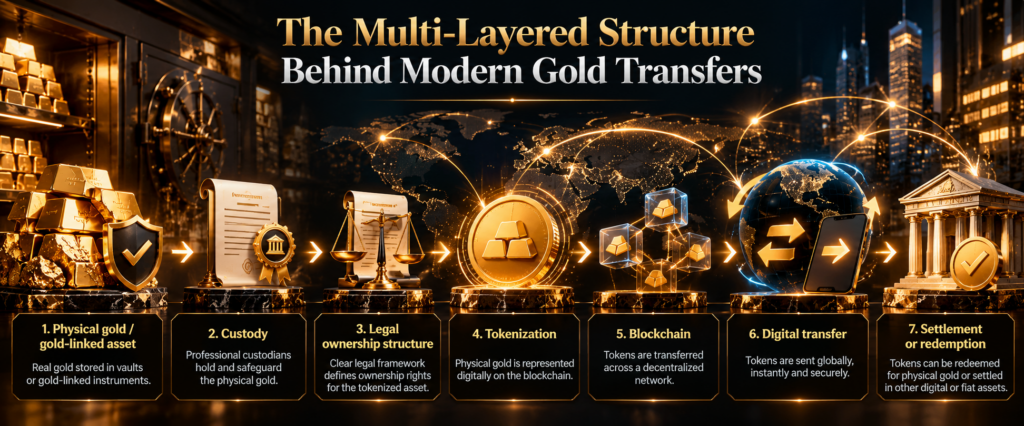
Each layer performs a different function.
The vault protects the physical asset.
The legal structure defines rights and obligations.
The blockchain records digital transactions.
Smart contracts automate defined processes.
And financial infrastructure connects the digital asset with currencies and other markets.
Why This Matters for Gold RWAs
Real-World Asset tokenization is ultimately about connecting assets from the physical economy with programmable digital infrastructure.
Gold is particularly interesting because it already has global recognition, established markets, standardized pricing, professional custody infrastructure, significant financial-market usage.
The World Gold Council’s 2026 research envisions a mature digital-gold market in which gold could become more fungible, accessible, movable and usable across financial systems while maintaining clear legal ownership and assurance of physical backing. World Gold Council
That vision is broader than simply putting gold on a blockchain.
It is about creating digital infrastructure around gold.
FAQ
Does tokenization eliminate gold vaults?
No. Tokenization can create a digital layer around gold, but underlying physical assets may still require professional custody and verification.
Can gold be transferred without physically moving it?
Yes. A tokenized asset can potentially be transferred digitally while the underlying gold remains in custody.
Does blockchain prove that the gold exists?
No. Blockchain can prove the existence and movement of tokens on-chain, but off-chain backing requires independent custody records, attestations, audits or other verification mechanisms.
What is digital settlement?
Digital settlement refers to completing a transaction through digital infrastructure, including the transfer of an asset and corresponding consideration, without necessarily requiring physical delivery of the underlying commodity.
Conclusion
The future of gold may not be about choosing between physical gold and digital gold.
Instead, the market could increasingly combine the two.
Physical custody provides the connection to the underlying asset, while blockchain can provide a programmable infrastructure for recording, transferring and using gold-linked value.
This creates a potential bridge between the traditional gold market and the emerging RWA economy.
The result could be a gold market that is not only stored and traded, but also increasingly transferable, programmable and integrated with digital financial infrastructure.