Author: ggd-admin

  • Gold RWA Explained: How Real-World Assets Are Moving Gold On-Chain

    Gold RWA Explained: How Real-World Assets Are Moving Gold On-Chain

    Gold has traditionally existed through physical bars, coins, ETFs and other financial products. Blockchain technology is creating another possibility: representing gold-related value through digital infrastructure.

    This concept is part of the broader Real-World Asset (RWA) movement.

    But what exactly is Gold RWA, how does it work, and why is gold becoming an important asset in the tokenization industry?

    What Is Gold RWA?

    Gold RWA refers to gold or gold-related value represented through blockchain-based infrastructure.

    RWA stands for Real-World Asset, describing assets or financial interests that exist outside blockchain networks but can be represented digitally on-chain.

    Gold is particularly relevant because it already has a large and established global market. The World Gold Council estimates that more than 220,000 tonnes of gold have been mined throughout history, with the above-ground stock valued at approximately $31 trillion at the end of 2025. (World Gold Council)

    Tokenization creates a bridge between this traditional asset and blockchain infrastructure.

    How Does Gold RWA Work?

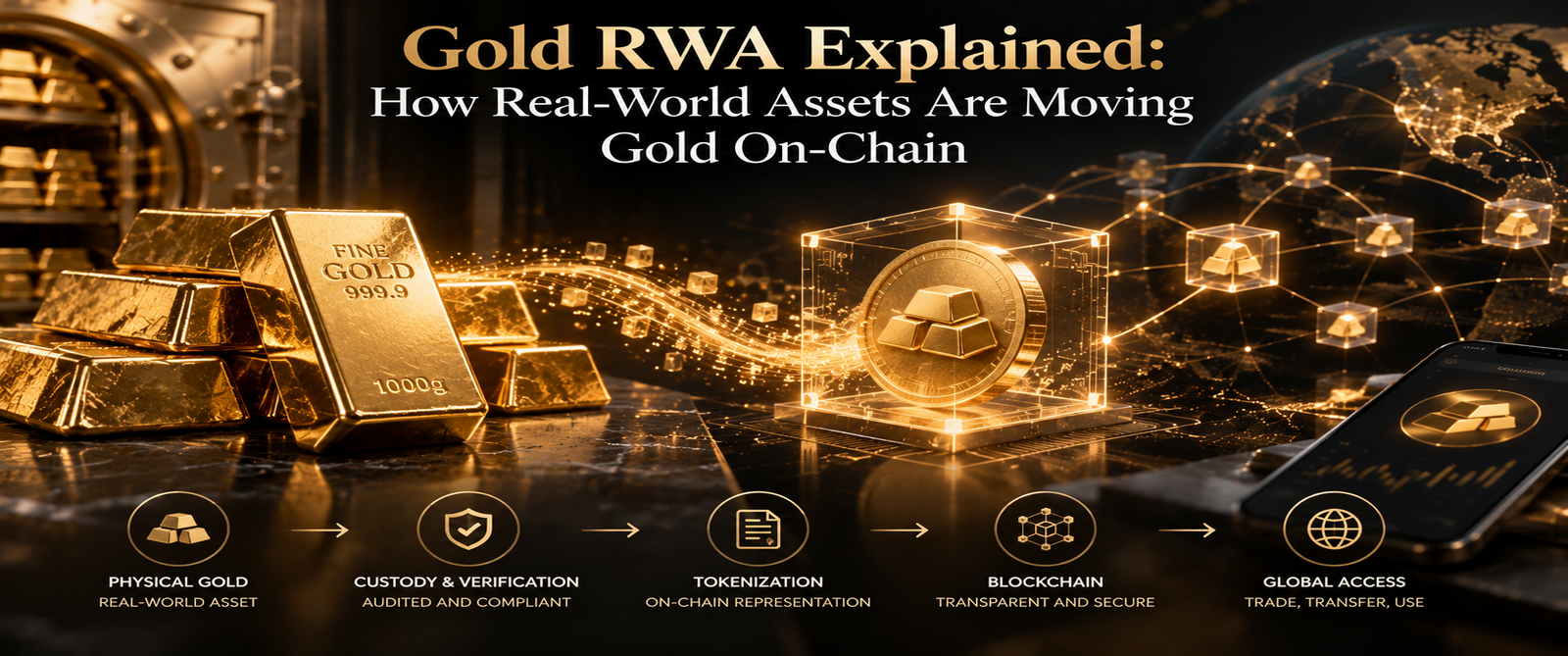
    A simplified Gold RWA structure can include several layers:

    1. Underlying Asset

    The first layer is the asset supporting the digital representation.

    Depending on the project, this could involve:

    • Physical gold
    • A gold ETF
    • Another financial instrument linked to gold

    The exact structure is important because different tokenized gold products can represent different forms of economic exposure.

    2. Legal and Custody Structure

    If physical gold is involved, it needs to be properly held and managed.

    The legal structure also determines what rights the token holder actually has, including ownership, redemption and transfer rights.

    3. Blockchain Token

    The asset or economic exposure can then be represented through a blockchain token.

    This allows the digital representation to potentially be transferred and integrated with blockchain applications.

    4. Verification

    A Gold RWA system also needs mechanisms to establish the relationship between the digital token and its underlying asset.

    These mechanisms can include attestations, reports, custody records and on-chain information.

    The blockchain itself records transactions, but on-chain activity alone does not prove that an off-chain asset exists.

    Why Is Gold Becoming Important in RWA?

    Gold is already a globally recognized asset with established financial markets.

    Tokenization can potentially add new digital capabilities, including:

    Divisibility — gold-related value can be represented in smaller digital units.

    On-chain transfer — tokens can potentially move between compatible blockchain addresses.

    Programmability — tokens can interact with smart contracts and other blockchain applications.

    Digital accessibility — users can interact with gold-related value through digital wallets and Web3 infrastructure.

    The market is already expanding. CoinGecko reported that tokenized commodities reached approximately $5.55 billion in market capitalization by the end of Q1 2026, with gold-backed tokens accounting for most of the growth. Tokenized gold also generated approximately $90.7 billion in spot trading volume during Q1 2026. (CoinGecko)

    Gold RWA and Web3

    One of the interesting aspects of Gold RWA is that it connects traditional assets with the programmable nature of blockchain.

    Instead of gold-related value existing only within traditional financial infrastructure, tokenized representations can potentially interact with:

    • Blockchain wallets
    • Smart contracts
    • DeFi applications
    • On-chain settlement
    • Digital asset ecosystems

    The World Gold Council has also been exploring shared infrastructure for digital gold, including custody, reconciliation, compliance and redemption. (World Gold Council)

    This shows that tokenized gold is becoming a broader infrastructure discussion rather than simply a cryptocurrency trend.

    How Gold on Chain Uses the Gold RWA Model

    Gold on Chain is developing an on-chain gold ecosystem through Global Gold DAO.

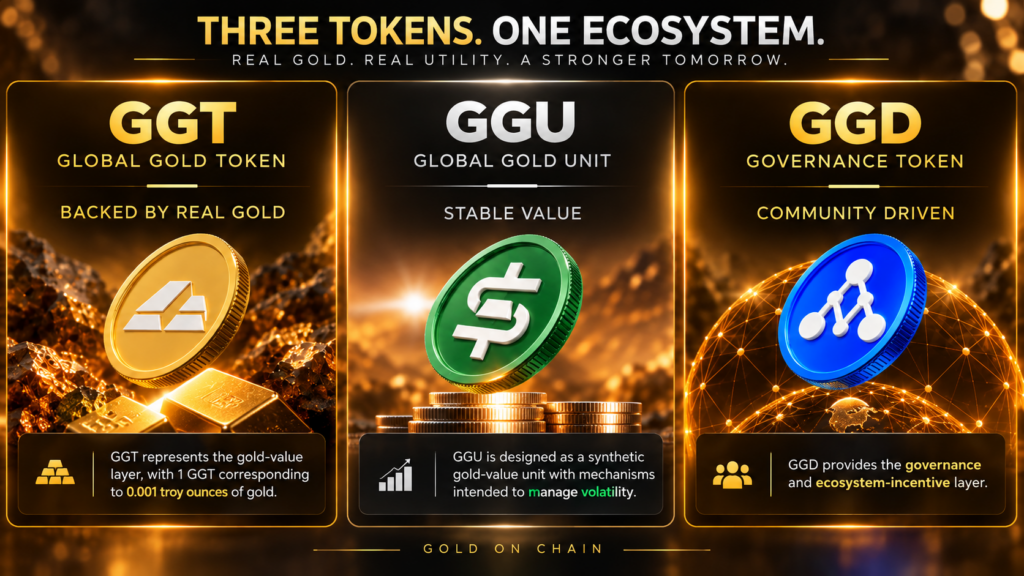
    Its current architecture uses three main components:

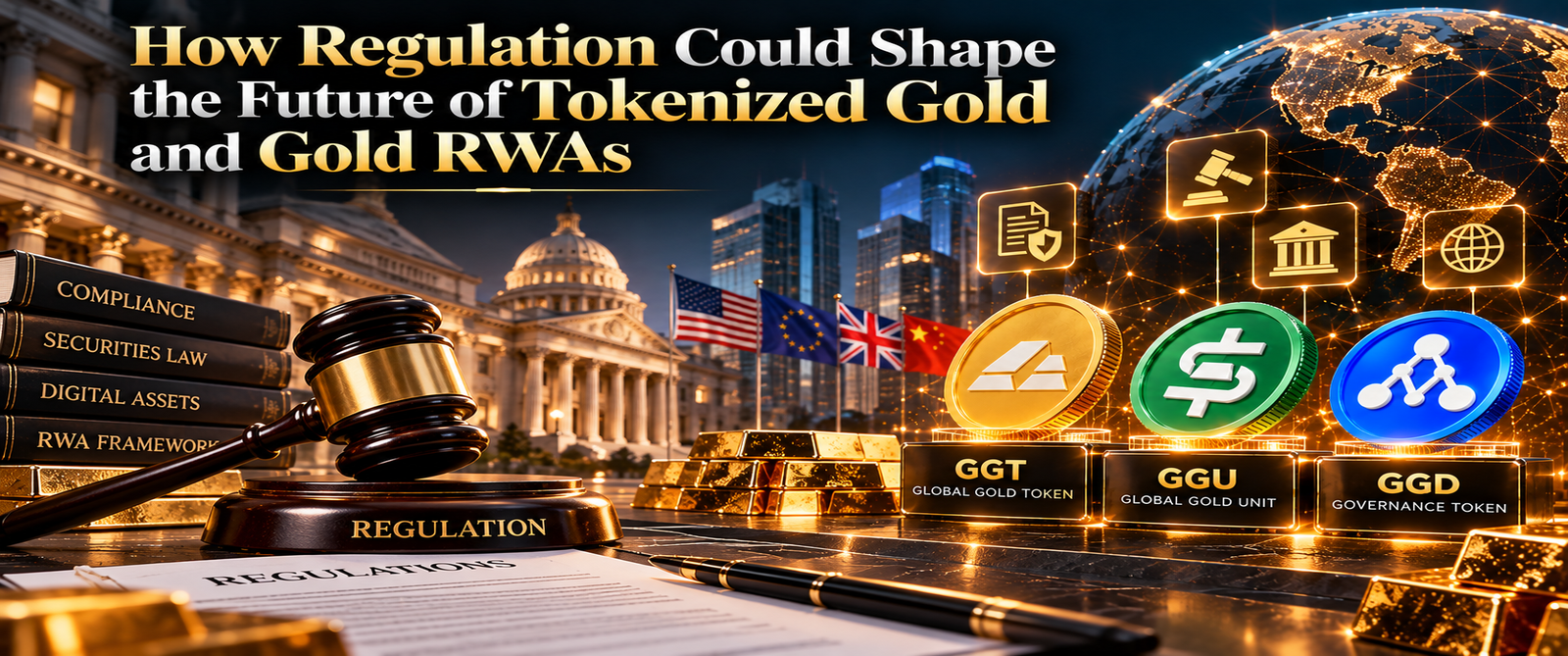
    • GGT — gold-value layer
    • GGU — synthetic gold-value and volatility-management layer
    • GGD — governance and ecosystem incentives

    According to the current Whitepaper, 1 GGT corresponds to 0.001 troy ounces of gold, while the current underlying asset is the CSOP Gold ETF (3030.HK). Direct physical gold is planned for a later phase. (Gold on Chain)

    This distinction is important: Gold RWA does not necessarily mean that every token is directly backed by physical gold today. The underlying structure depends on the specific project.

    The Future of Gold RWA

    The tokenization of gold sits at the intersection of traditional finance, commodities and Web3.

    As blockchain infrastructure develops, gold-related assets may become increasingly connected to digital settlement, smart contracts and on-chain financial applications.

    However, the underlying asset, custody, legal rights, compliance and verification mechanisms remain just as important as the blockchain technology itself.

    Gold RWA is ultimately about creating a bridge between established gold markets and a new generation of digital financial infrastructure.

    FAQ

    What does Gold RWA mean?
    Gold RWA refers to gold or gold-related value represented through blockchain-based infrastructure.

    Is Gold RWA the same as physical gold?
    Not necessarily. Different projects can use physical gold, ETFs or other gold-related structures.

    Why is gold being tokenized?
    Tokenization can introduce digital transferability, divisibility, programmability and integration with blockchain applications.

    What is GGT?
    GGT is the gold-value layer of the Gold on Chain ecosystem. The current protocol reference is 1 GGT = 0.001 troy ounces of gold. (Gold on Chain)
  • What Is GGT? Understanding the Gold Value Token on Gold on Chain

    What Is GGT? Understanding the Gold Value Token on Gold on Chain

    As gold increasingly enters the world of blockchain and Real-World Assets, new digital structures are being developed to represent gold-related value on-chain.

    One example is GGT, the gold-value layer of the Gold on Chain ecosystem.

    But what exactly is GGT, how is its value defined, and how does it fit into Global Gold DAO?

    What Is GGT?

    GGT is the gold-value token within the GGD Protocol.

    According to the current Gold on Chain Whitepaper, the conversion reference is:

    1 GGT = 0.001 troy ounces of gold

    GGT is designed as the value-anchor layer within the ecosystem, connecting gold-related value with blockchain infrastructure. (Gold on Chain)

    The current underlying asset identified by the protocol is the CSOP Gold ETF (3030.HK).

    The project’s documentation also describes direct physical gold as a planned future underlying asset. (Gold on Chain)

    How Does GGT Relate to Gold?

    GGT is designed around a standardized gold-value reference.

    This creates a digital unit that can interact with blockchain infrastructure while remaining connected to gold-related value.

    The structure can be simplified as:

    Gold-related asset → GGT value layer → Blockchain infrastructure

    This is different from simply creating a cryptocurrency with a name related to gold.

    The underlying asset and legal structure are important parts of the model.

    What Can GGT Be Used For?

    According to the Gold on Chain documentation, GGT supports several functions within the ecosystem, including:

    On-Chain Transfer

    GGT can operate as a blockchain-based asset and be transferred between compatible addresses according to the protocol rules.

    Subscription and Redemption

    The protocol documentation describes USDC/USDT subscription and redemption mechanisms for GGT.

    Gold-Value Representation

    GGT provides the primary gold-value reference within the three-token architecture.

    Ecosystem Integration

    Because GGT exists on blockchain infrastructure, it can interact with other components of the Gold on Chain ecosystem.

    The protocol currently launches GGT on BNB Chain, with future cross-chain expansion subject to DAO governance. (Gold on Chain)

    GGT, GGU and GGD: What’s the Difference?

    GGT is only one component of the wider Gold on Chain ecosystem.

    This three-token structure is one of the central elements of the GGD Protocol.

    GGT provides the gold-value foundation, GGU is designed around volatility-management mechanisms, while GGD supports governance and ecosystem participation. (Gold on Chain)

    Why Is GGT Relevant to Gold RWA?

    Traditional gold markets already have established infrastructure.

    The development of tokenized gold introduces another layer: blockchain-based representation and settlement.

    GGT is designed within this broader RWA concept, connecting a gold-related financial asset with an on-chain token structure.

    This is part of a wider industry trend. Tokenized commodities grew substantially during Q1 2026, reaching approximately $5.55 billion, according to CoinGecko. Gold-backed tokens represented the majority of that market. (CoinGecko)

    Meanwhile, regulators and industry organizations are also examining the infrastructure required for tokenized gold. In September 2026, the UK’s Financial Conduct Authority opened a call for input on how tokenized gold could be used for trading, transferring, pledging and holding gold in wholesale markets. (FCA)

    Understanding the GGT Structure

    When looking at any tokenized gold project, it is important to understand what the token actually represents.

    For GGT, the current documentation identifies:

    • Reference: 0.001 troy ounces of gold per GGT
    • Current underlying asset: CSOP Gold ETF (3030.HK)
    • Launch network: BNB Chain
    • Future development: direct physical gold is planned for a later phase

    The project’s Whitepaper also describes a legal structure designed to separate the issuance arrangement from the underlying asset structure. (Gold on Chain)

    The Role of GGT in Gold on Chain

    Gold on Chain is building an ecosystem that connects gold RWA, blockchain infrastructure and decentralized governance.

    Within that ecosystem, GGT represents the gold-value foundation.

    GGU adds the synthetic-value and volatility-management component, while GGD provides governance and ecosystem incentives.

    Together, these components form the core architecture of Global Gold DAO.

    Conclusion

    GGT represents the gold-value layer of the Gold on Chain ecosystem, connecting a defined gold-value reference with blockchain infrastructure.

    Its current underlying asset is the CSOP Gold ETF, while the project’s documentation describes direct physical gold as part of a later phase.

    As tokenized gold and RWA infrastructure continue to develop, GGT illustrates one approach to bringing gold-related value into an on-chain ecosystem.

    FAQ

    What is GGT?
    GGT is the gold-value token within the GGD Protocol.

    How much gold does 1 GGT represent?
    The protocol defines a reference of 1 GGT = 0.001 troy ounces of gold. (Gold on Chain)
    What is currently underlying GGT?
    The current underlying asset identified by the protocol is the CSOP Gold ETF (3030.HK). (Gold on Chain)

    Which blockchain does GGT use?
    GGT launches on BNB Chain according to the current protocol documentation. (Gold on Chain)

    What is the difference between GGT and GGD?
    GGT is the gold-value layer, while GGD is focused on governance and ecosystem incentives.

    Image

  • From Gold ETFs to On-Chain Gold: Understanding the Evolution of Digital Gold

    From Gold ETFs to On-Chain Gold: Understanding the Evolution of Digital Gold

    The way people interact with gold has changed significantly over time.

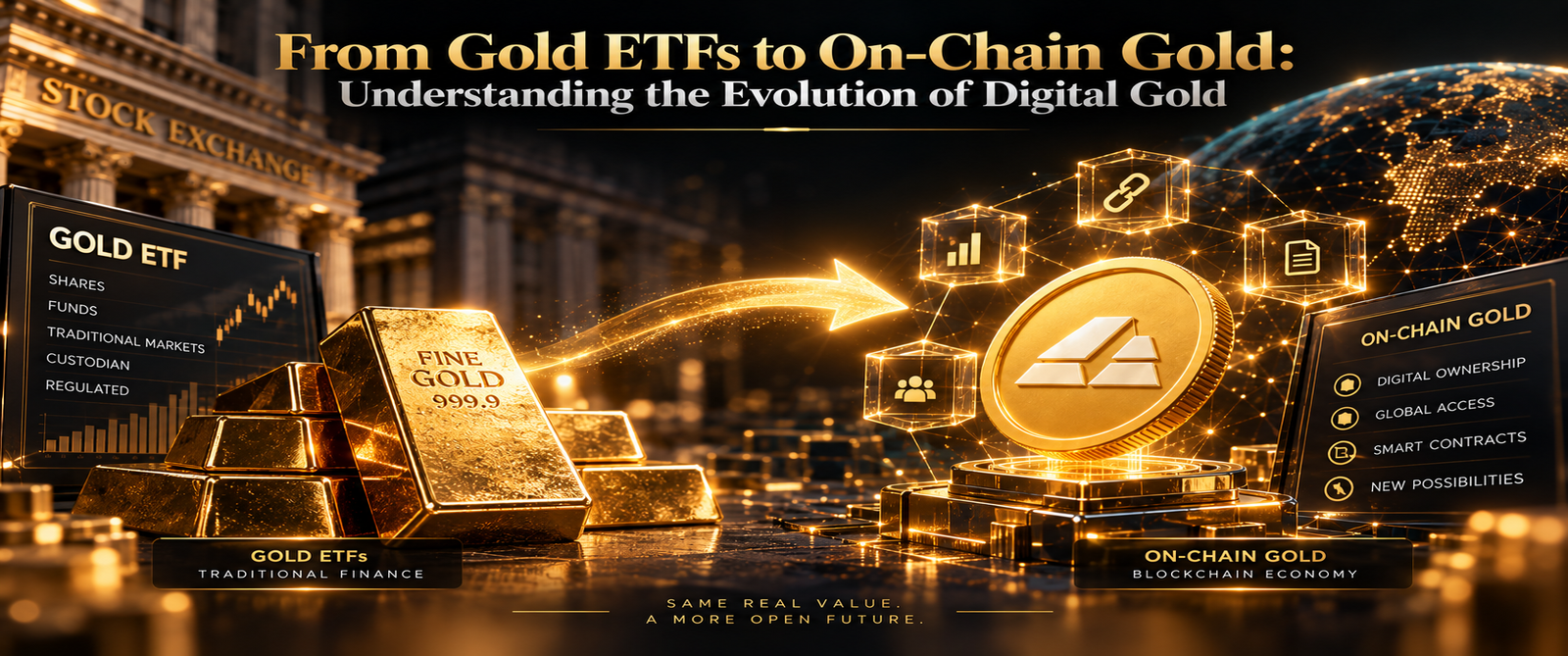
    Physical bullion created direct ownership of a tangible asset. Gold ETFs introduced a more accessible financial-market structure. Now, blockchain technology is creating another stage: on-chain gold.

    This evolution is not simply about replacing one form of gold with another. Each model introduces different infrastructure and capabilities.

    From Physical Gold to Gold ETFs

    For centuries, gold ownership primarily meant owning physical bullion.

    Bars and coins provide a tangible form of gold ownership, but physical assets also require storage, transportation, security and specialized handling.

    Gold ETFs introduced another model.

    Instead of personally holding gold bars, investors can hold shares in a financial product designed to track gold-related value.

    This made gold exposure easier to integrate with traditional financial markets.

    What Is On-Chain Gold?

    On-chain gold refers to gold or gold-related value represented and managed through blockchain infrastructure.

    Instead of existing exclusively inside a traditional financial system, the digital representation can operate through blockchain networks.

    This can introduce capabilities such as:

    • On-chain transfers
    • Digital wallets
    • Smart-contract interaction
    • Programmable transactions
    • Integration with Web3 applications

    The exact capabilities depend on the design of each project.

    Why Is Blockchain Relevant to Gold?

    Gold itself has not changed.

    The innovation is in the infrastructure surrounding gold-related value.

    Blockchain can create a digital layer where tokens can be transferred between compatible addresses and interact with smart contracts.

    This can potentially make gold-related assets more compatible with the broader digital-asset ecosystem.

    The UK’s Financial Conduct Authority is currently examining this development. In September 2026, the FCA launched a call for input on whether tokenizing gold could improve how gold is traded, transferred, pledged and held in UK wholesale markets.

    The RWA Connection

    On-chain gold is part of the broader Real-World Asset (RWA) movement.

    The basic concept is:

    Traditional asset → legal/financial structure → digital token → blockchain ecosystem

    Gold is particularly suitable for this discussion because it already has a globally established market and standardized valuation.

    CoinGecko’s 2026 RWA report found that tokenized commodities reached approximately $5.5 billion by the end of Q1 2026, driven largely by gold-backed tokens.

    Gold on Chain: Bringing Gold Value On-Chain

    Gold on Chain is building its ecosystem around this transition.

    The project’s current architecture uses three main components:

    The current underlying asset for GGT is the CSOP Gold ETF (3030.HK), while the Whitepaper describes a planned transition toward an ETF-plus-physical-gold structure.

    What Changes When Gold Goes On-Chain?

    Moving gold-related value onto blockchain infrastructure can introduce several new possibilities.

    1. Digital Transfer

    Tokens can potentially move between compatible blockchain addresses without using traditional securities settlement infrastructure.

    2. Programmability

    Smart contracts can define how digital assets are issued, transferred, converted or integrated with other applications.

    3. Composability

    Tokenized gold can potentially interact with other blockchain-based assets and financial applications.

    4. Global Digital Infrastructure

    Blockchain networks operate continuously, allowing digital assets to exist outside traditional market-hour structures.

    These characteristics are part of the broader reason why tokenized RWAs are attracting attention from both blockchain projects and financial institutions.

    The Future of Digital Gold

    The development of digital gold is moving beyond the simple question of how to represent gold electronically.

    The next question is how gold-related assets can interact with blockchain infrastructure, digital settlement, smart contracts and Web3 applications while maintaining appropriate custody, legal and compliance structures.

    Gold ETFs helped create a digital interface for traditional gold markets.

    Tokenization introduces another layer: on-chain infrastructure for gold-related value.

    Gold on Chain is developing within this broader transition, combining GGT, GGU and GGD into an ecosystem designed around gold value, volatility management and decentralized governance.

    Conclusion

    The evolution of gold can be viewed through several stages:

    Physical Gold → Gold ETFs → Tokenized Gold → On-Chain Gold Ecosystems

    Each stage introduces different ways to access, transfer and interact with gold-related value.

    Blockchain does not change the fundamental nature of gold. Instead, it creates new infrastructure around how gold-related value can be represented and used.

    As RWA tokenization continues to develop, on-chain gold is becoming an increasingly important part of the conversation about the future of digital assets.

    FAQ

    What is on-chain gold?
     On-chain gold refers to gold or gold-related value represented and managed through blockchain infrastructure.

    Is an on-chain gold token the same as physical gold?
     Not necessarily. The underlying asset and legal rights depend on the specific token structure.

    What is the difference between gold ETFs and on-chain gold?
     Gold ETFs operate through traditional financial markets, while on-chain gold uses blockchain infrastructure for its digital representation and potential transfer.

    What does GGT represent?
     GGT is the gold-value layer of Gold on Chain, with a reference of 0.001 troy ounces of gold per GGT.

  • How Regulation Could Shape the Future of Tokenized Gold and Gold RWAs

    How Regulation Could Shape the Future of Tokenized Gold and Gold RWAs

    Tokenized gold is connecting traditional gold markets with blockchain infrastructure.

    But technology alone cannot determine how this market develops.

    As tokenized gold becomes more relevant to financial institutions and investors, regulation, custody, legal rights and compliance are becoming equally important.

    Why Does Regulation Matter?

    A blockchain token does not automatically explain what the holder owns.

    Different tokenized-gold models can represent different things.

    For example, a token may be connected to:

    • Physical gold
    • A gold ETF
    • Another gold-related financial product
    • A defined economic interest

    Each structure can involve different legal rights, custody arrangements and redemption mechanisms.

    Clear regulation can help establish how these products should operate within existing financial markets.

    The FCA Is Studying Tokenized Gold

    A significant development came on September 14, 2026, when the UK’s Financial Conduct Authority launched a Call for Input on tokenised gold.

    The FCA is examining whether tokenization could improve how gold is:

    • Traded
    • Transferred
    • Pledged
    • Held

    The regulator is particularly interested in wholesale-market use cases and the possibility of tokenized gold being used as collateral. (fca.org.uk)

    The FCA also highlighted questions around the regulatory perimeter, including potential treatment under collective investment scheme and alternative investment fund frameworks. (fca.org.uk)

    Regulation Could Influence Institutional Adoption

    Institutional participants typically need clearly defined rules around assets and counterparties.

    For tokenized gold, this can include:

    Custody

    Where is the underlying gold held, and who is responsible for it?

    Legal Rights

    What does ownership of the token actually provide?

    Redemption

    Can the token be redeemed, and under what conditions?

    Compliance

    What KYC, AML and jurisdictional requirements apply?

    Transparency

    How can participants verify the relationship between the token supply and the underlying asset?

    These questions are particularly important when blockchain-based assets interact with traditional financial markets.

    Regulation and Digital Gold Infrastructure

    The regulatory discussion is happening alongside broader infrastructure development.

    In March 2026, the World Gold Council and Boston Consulting Group published research proposing a shared infrastructure model for digital gold.

    The concept, called “Gold as a Service,” aims to connect physical gold custody with digital systems used to issue and manage gold-backed products, while standardizing processes such as custody coordination, reconciliation, compliance and redemption. (gold.org)

    This illustrates how the future of digital gold may depend on both blockchain technology and supporting financial infrastructure.

    How Gold on Chain Approaches Compliance

    Gold on Chain’s protocol documentation includes compliance and transparency as part of its architecture.

    The Whitepaper describes mechanisms including KYT/KYA screening, AML controls, restricted-jurisdiction controls and third-party security audits. (goldonchain.io)

    The project’s transparency page separately identifies the current GGT underlying asset as CSOP Gold ETF (3030.HK) and lists the current custody chain associated with that asset. It also states that underlying-asset reports, valuation reports and smart-contract audit information are to be disclosed according to the project’s stated publication status. (goldonchain.io)

    What Could Regulation Change?

    Regulation could influence several parts of the tokenized-gold market.

    Market access: who can issue, distribute or trade certain products.

    Custody: standards for safeguarding underlying assets.

    Disclosure: what information issuers need to provide.

    Redemption: how token holders can exercise defined rights.

    Collateral: how tokenized gold can potentially be used within financial transactions.

    Cross-border activity: how digital gold products interact across jurisdictions.

    The exact regulatory approach will differ between jurisdictions and product structures.

    Gold RWA and the Next Stage of Financial Infrastructure

    Tokenized gold is part of a broader RWA movement.

    CoinGecko reported that tokenized RWAs reached approximately $19.3 billion by the end of Q1 2026, while tokenized commodities reached approximately $5.5 billion, driven largely by gold-backed tokens. (coingecko.com)

    As this market grows, regulation may increasingly focus on how blockchain-based assets interact with established financial infrastructure.

    For Gold RWA projects, this means that technology, asset backing and compliance need to develop together.

    Conclusion

    The future of tokenized gold will be shaped by more than blockchain adoption.

    Clear legal structures, custody, asset verification, compliance and market infrastructure will all influence how tokenized gold develops.

    The FCA’s current work on tokenised gold shows that regulators are actively examining how the technology could be used within wholesale financial markets. (fca.org.uk)

    At the same time, institutions and industry organizations are building infrastructure designed to connect physical gold with digital systems.

    For Gold on Chain, this broader transition is reflected in an ecosystem built around GGT, GGU and GGD, with documented mechanisms for asset structure, compliance, transparency and governance. (goldonchain.io)

    As Gold RWA develops, regulation may become not simply a constraint, but an important part of the infrastructure required for digital gold to operate at greater scale.

    FAQ

    Why is regulation important for tokenized gold?
     Because tokenized gold can involve physical assets, financial products, custody, legal rights and cross-border activity.

    What is the FCA doing about tokenized gold?
     The FCA launched a Call for Input on September 14, 2026, examining opportunities and risks for tokenised gold in UK wholesale markets. (fca.org.uk)

    Does regulation guarantee that a tokenized-gold project is safe?
     No. Regulation and compliance are important components, but they do not eliminate market, technology, custody or other risks.

    Does Gold on Chain have a compliance framework?
     Its current Whitepaper describes KYC/KYT, AML, jurisdictional controls, transparency measures and security audits as components of the protocol architecture. (goldonchain.io)

  • Why Are Financial Markets Exploring Tokenized Gold in 2026?

    Why Are Financial Markets Exploring Tokenized Gold in 2026?

    Gold has always been an important financial asset, but the infrastructure surrounding gold is changing.

    In 2026, financial institutions, asset managers, technology companies and regulators are paying increasing attention to tokenized gold and the broader Real-World Asset (RWA) market.

    The reason is not simply the popularity of cryptocurrencies.

    Tokenization is being explored as a way to connect established assets with modern digital financial infrastructure.

    What Is Tokenized Gold?

    Tokenized gold refers to a blockchain-based digital representation of gold or gold-related value.

    Depending on the structure, a token may represent physical gold held in custody, exposure to a gold-backed financial product, or another defined gold-related asset.

    This distinction is important because different tokenized-gold products can have different custody arrangements, legal rights and redemption mechanisms.

    The World Gold Council describes tokenized gold as part of the broader development of digital gold infrastructure, alongside existing products such as gold ETFs and vaulted digital gold accounts. (gold.org)

    Why Is Interest Growing in 2026?

    The tokenized RWA market has expanded rapidly.

    CoinGecko reported that tokenized RWAs reached approximately $19.3 billion by the end of Q1 2026, while tokenized commodities grew to approximately $5.5 billion. Gold-backed tokens accounted for most of the growth in the tokenized commodities category. (coingecko.com)

    Tokenized gold also recorded approximately $90.7 billion in spot trading volume during Q1 2026, already exceeding the full-year 2025 volume reported by CoinGecko. (coingecko.com)

    These numbers show that tokenized gold has developed beyond a purely experimental concept.

    Financial Institutions Are Exploring the Model

    Another important development is the participation of established financial institutions.

    In April 2026, OCBC, Lion Global Investors and DigiFT launched a tokenized physical gold fund on public blockchains, providing regulated on-chain exposure to gold for institutional and accredited investors. (ocbc.com)

    In June, DBS announced a tokenized physical-gold offering for customers in Singapore, with the bank stating that the tokens would be backed by physical gold held in a dedicated vault. (dbs.com)

    These developments illustrate an important trend: tokenized gold is increasingly being explored through regulated financial infrastructure, not only crypto-native platforms.

    What Advantages Can Tokenization Provide?

    Digital Transfer

    Blockchain-based tokens can potentially be transferred between compatible addresses without relying exclusively on traditional settlement infrastructure.

    Fractional Representation

    Tokenization can represent defined fractions of an underlying asset, creating smaller digital units.

    Programmability

    Tokens can interact with smart contracts and other blockchain applications.

    Integration

    Tokenized gold can potentially connect gold-related value with digital wallets, Web3 applications and other on-chain infrastructure.

    The World Gold Council’s 2026 research describes a future digital-gold infrastructure where gold could become easier to access, move, use and integrate across financial systems while maintaining clear ownership and physical backing. (gold.org)

    Regulation Is Also Becoming Part of the Conversation

    The increasing institutional interest is accompanied by regulatory attention.

    On September 14, 2026, the UK’s Financial Conduct Authority published a Call for Input specifically focused on tokenised gold in UK wholesale markets.

    The FCA is examining whether tokenization could improve how gold is traded, transferred, pledged and held, including potential use as wholesale collateral. (fca.org.uk)

    The consultation closes on October 23, 2026. (fca.org.uk)

    This regulatory attention is another indication that tokenized gold is becoming relevant to discussions about financial-market infrastructure.

    How Gold on Chain Fits Into This Development

    Gold on Chain is developing its own gold RWA ecosystem through Global Gold DAO.

    Its current architecture consists of three main components:

    • GGT — gold-value layer
    • GGU — synthetic gold-value and volatility-management layer
    • GGD — governance and ecosystem incentives

    The current GGT structure uses the CSOP Gold ETF (3030.HK) as its underlying asset, with 1 GGT corresponding to 0.001 troy ounces of gold. The project’s Whitepaper describes direct physical gold as a planned later phase. (goldonchain.io)

    This places Gold on Chain within the broader movement toward connecting gold-related value with blockchain infrastructure.

    What Comes Next?

    The development of tokenized gold is likely to involve more than simply creating new tokens.

    Important areas include:

    • Asset custody
    • Legal ownership
    • Compliance
    • Redemption
    • Liquidity
    • Interoperability
    • Transparency
    • Institutional infrastructure

    The World Gold Council is also working on the concept of shared digital-gold infrastructure designed to connect physical gold custody with digital systems for issuance and management. (gold.org)

    Conclusion

    Financial markets are exploring tokenized gold because blockchain technology can potentially add new capabilities to an established global asset.

    The growth of tokenized gold, the participation of financial institutions and increasing regulatory attention all point to a market that is developing beyond its early experimental stage.

    The central question is no longer simply whether gold can be represented on a blockchain.

    It is how gold, financial infrastructure and blockchain technology can work together while maintaining clear asset structures, custody, compliance and transparency.

    FAQ

    Why is tokenized gold becoming popular in 2026?
     Growing RWA adoption, blockchain infrastructure and institutional interest are contributing to increased attention around tokenized gold.

    Are banks exploring tokenized gold?
     Yes. OCBC and DBS, among other institutions, announced tokenized-gold initiatives in 2026. (ocbc.com)

    What is Gold RWA?
     Gold RWA refers to gold or gold-related value represented through blockchain-based infrastructure.

    What is the current underlying asset for GGT?
     The current GGT underlying asset identified by Gold on Chain is CSOP Gold ETF (3030.HK). (goldonchain.io)

    Copyright © 2026 Global Gold DAO ecosystem. All rights reserved.

  • What Is Tokenized Gold and How Does It Work?

    What Is Tokenized Gold and How Does It Work?

    Gold has traditionally been traded and held through physical bars, coins, financial products, and other established market structures. Blockchain technology is now creating another possibility: representing gold-related value through digital tokens.

    This concept is known as tokenized gold.

    Tokenized gold combines the characteristics of gold-related assets with blockchain infrastructure, potentially making them easier to transfer, divide, and integrate with digital applications.

    But how does tokenized gold actually work? What does a gold token represent, and how is it different from simply owning physical gold?

    What Is Tokenized Gold?

    Tokenized gold is a blockchain-based digital representation of gold or gold-related value.

    The exact meaning of a gold token depends on the project issuing it.

    In some structures, a token may represent a defined quantity of physical gold held by a custodian. In others, it may represent exposure to a gold-backed financial asset or another gold-related structure.

    For this reason, the most important question is not simply:

    “Is this a gold token?”

    It is:

    “What exactly does the token represent, and what assets or rights support it?”

    Understanding the underlying structure is essential when evaluating any tokenized gold model.

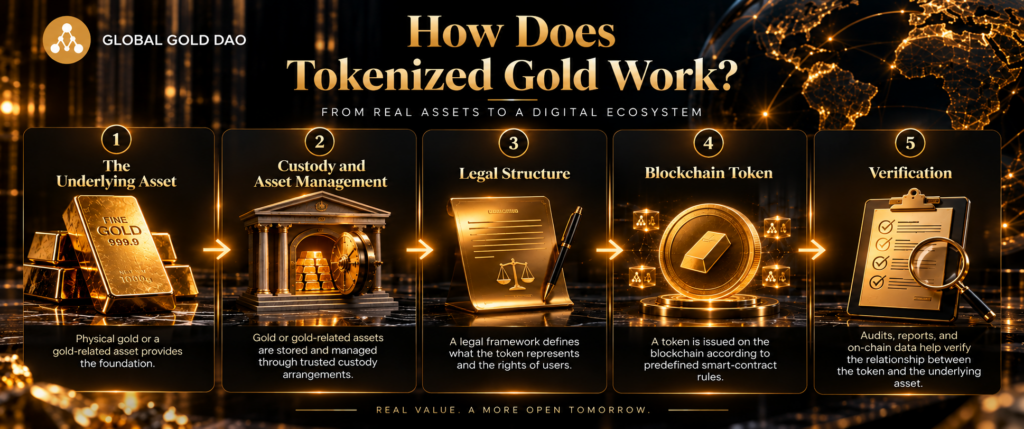
    How Does Tokenized Gold Work?

    A simplified tokenization model can be divided into several layers.

    1. The Underlying Asset

    The first layer is the asset itself.

    For a gold-related token, the underlying structure may involve physical gold, a gold-backed exchange-traded product, or another asset linked to gold.

    The underlying asset provides the foundation for the token’s economic structure.

    2. Custody and Asset Management

    If the model uses physical gold, the gold needs to be stored and managed through appropriate custody arrangements.

    If the underlying asset is a financial product, the structure instead needs to define how that asset is held and managed.

    This layer is critical because the blockchain token alone does not establish ownership of an off-chain asset.

    3. Legal Structure

    A tokenized gold project also needs a legal framework that defines what the token represents and what rights users have.

    Depending on the project, this may include:

    • ownership rights;
    • redemption rights;
    • transfer rights;
    • eligibility requirements;
    • custody arrangements;
    • issuer responsibilities.

    The legal structure can vary significantly between tokenized gold projects.

    4. Blockchain Token

    The next layer is the blockchain representation.

    The project issues a token according to predefined smart-contract rules.

    The token can then be transferred between compatible blockchain addresses and potentially integrated with other applications.

    5. Verification

    The final piece is verification.

    A credible tokenized gold system needs mechanisms that allow users and other stakeholders to understand the relationship between the digital supply and the underlying asset.

    Depending on the project, this can involve asset reports, attestations, audits, on-chain data, custodial records, or other forms of disclosure.

    What Are the Benefits of Tokenized Gold?

    Tokenization does not automatically make gold more valuable. Its primary innovation is the infrastructure used to represent and interact with gold-related value.

    Greater Divisibility

    Physical gold bars can be difficult to divide into small units.

    A digital token can represent a defined fraction of an underlying asset.

    For example, Gold on Chain defines 1 GGT as corresponding to 0.001 troy ounces of gold, creating a standardized digital unit for its gold-value layer.

    On-Chain Transfer

    Tokenized gold can potentially be transferred between blockchain addresses.

    This allows the digital representation of gold-related value to operate within blockchain infrastructure rather than relying exclusively on traditional settlement systems.

    Programmability

    Blockchain tokens can interact with smart contracts.

    This means tokenized gold can potentially become part of broader digital ecosystems rather than existing only as a passive representation of an asset.

    Transparency

    Blockchain networks provide publicly verifiable transaction records.

    This can make the movement and supply of digital tokens easier to track.

    However, there is an important distinction:

    On-chain transparency does not automatically prove that an off-chain asset exists.

    Verification of the underlying asset requires additional mechanisms.

    Digital Accessibility

    Tokenized gold can provide a digital interface for interacting with gold-related assets.

    Instead of dealing exclusively with physical bars, users can interact with blockchain-based representations through compatible wallets and applications.

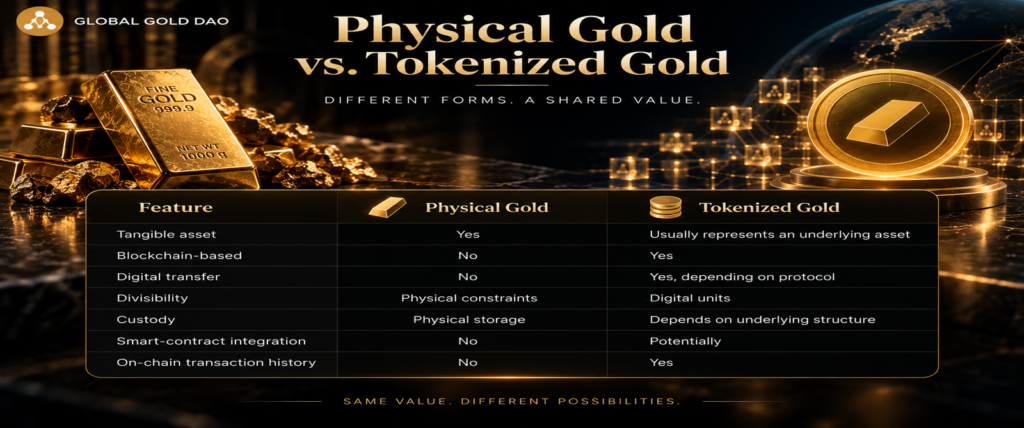
    Tokenized Gold vs. Physical Gold

    Tokenized gold and physical gold are fundamentally different forms of asset representation.

    Physical gold is a tangible commodity.

    Tokenized gold is a digital representation connected to an underlying asset or defined gold-related value.

    Neither model should automatically be considered superior.

    They serve different purposes and operate through different infrastructures.

    Is Tokenized Gold the Same as Digital Gold?

    The terms “digital gold” and “tokenized gold” are sometimes used interchangeably, but they can describe different concepts.

    Digital gold is a broad term that can refer to different forms of digital exposure to gold.

    Tokenized gold is more specific: it generally refers to a blockchain-based token representing gold or gold-related value.

    This distinction matters because not every digital gold product uses blockchain technology.

    Tokenized Gold and Real-World Assets

    Tokenized gold is one example of the broader Real-World Asset (RWA) movement.

    RWA technology aims to connect assets that exist outside blockchain networks with digital infrastructure.

    Gold is particularly relevant to this movement because it already has a long-established global market.

    The tokenization process creates a bridge:

    Traditional asset → Legal and custody structure → Digital token → Blockchain ecosystem

    This bridge is one of the reasons tokenized gold has become an important topic in the RWA sector.

    How Gold on Chain Approaches Tokenized Gold

    Gold on Chain is developing an on-chain gold ecosystem through the Global Gold DAO.

    Its current structure uses three main components:

    • GGT — the gold-value layer;
    • GGU — a synthetic gold-value unit designed to provide volatility-management mechanisms;
    • GGD — the governance and ecosystem incentive layer.

    According to the project’s current documentation, GGT corresponds to 0.001 troy ounces of gold, with the current underlying asset identified as the CSOP Gold ETF (3030.HK). The project’s documentation also describes direct physical gold as a planned future underlying asset.

    This structure illustrates how tokenized gold can involve more than simply creating a token. It can include asset backing, issuance structures, conversion mechanisms, governance, and blockchain infrastructure.

    What Should Users Look for in a Tokenized Gold Project?

    Before evaluating any tokenized gold project, several questions are worth asking.

    What is the underlying asset?

    Understand exactly what supports the token.

    Who holds or manages the underlying asset?

    Custody and asset management are fundamental parts of the structure.

    What does the token legally represent?

    A token name alone does not define its legal rights.

    How is the underlying asset verified?

    Look for clear disclosures, reports, attestations, or other verification mechanisms.

    How does redemption work?

    Understand whether and how the token can be converted into another asset or form of value.

    What blockchain does it use?

    The blockchain determines how the token operates within the broader digital ecosystem.

    What are the smart-contract rules?

    Smart contracts define how tokens are issued, transferred, converted, or otherwise used.

    The Future of Tokenized Gold

    Tokenized gold sits at the intersection of traditional commodities and blockchain technology.

    As RWA infrastructure develops, gold may become increasingly connected to digital ecosystems through tokenization, on-chain settlement, and programmable asset infrastructure.

    However, the long-term development of tokenized gold will depend on more than blockchain adoption.

    Asset verification, custody, legal frameworks, compliance, liquidity, security, and user understanding will all remain important.

    The technology provides the infrastructure. The quality of the underlying asset structure determines how that infrastructure is used.

    Conclusion

    Tokenized gold represents a new way of connecting gold-related value with blockchain technology.

    By transforming defined gold-related assets or rights into blockchain-based tokens, tokenization can enable new forms of divisibility, transfer, transparency, and programmability.

    For users and institutions exploring the RWA sector, understanding the underlying asset and legal structure is just as important as understanding the blockchain technology itself.

    As projects such as Gold on Chain develop their on-chain gold ecosystems, tokenized gold is becoming an increasingly important area to watch in the evolution of Real-World Assets.

    Copyright © 2026 Global Gold DAO ecosystem. All rights reserved.